If you see several cats sitting together, the traditional name for that group of cats is a “clowder.” English also has other feline collective nouns, including “glaring,” “clutter,” and “kindle,” while “colony” is commonly used for community or free-roaming cats living around the same area. The best word depends on whether you are talking about adult pets, kittens, community cats, or simply using a colorful collective noun.
Quick answer: A group of cats is most commonly called a clowder. Other terms include “glaring” or “clutter of cats,” while a group of related kittens is normally called a “litter,” and the less common traditional term “kindle” can also refer to kittens.
| Group of Cats | Usually refers to | How common is it? |
|---|---|---|
| Clowder | A general gathering of cats | Standard traditional collective noun |
| Glaring | Several cats together, often used playfully | Rare |
| Clutter | A group or cluster of cats | Uncommon |
| Colony | Community or free-roaming cats living together | Common in animal welfare |
| Litter | Kittens born to the same mother | Very common |
| Kindle | A group of kittens | Traditional but rare |
| Destruction | A group of wild cats in word lists | Mostly playful or literary |
Key Takeaways
Clowder is the clearest traditional collective noun for several adult cats.
Dictionaries define a clowder simply as a group or cluster of cats, without setting an official minimum number.
Colony is more useful than clowder when discussing free-roaming or community cats sharing an area.
“Litter” is the everyday term for kittens born together, while “kindle” is an older and much less common alternative.
Cats can form real social groups when resources and relationships allow, even though they can also live and hunt independently.
What Is a Group of Cats Called?
The standard answer is a clowder of cats. Dictionary.com defines clowder as a group or cluster of cats, and Collins gives essentially the same meaning in American English. That makes “clowder” the strongest answer when a quiz, vocabulary question, crossword, or general conversation asks for the collective noun for cats.
You do not have to use the word every time several cats appear in one place. In ordinary American conversation, saying “a group of cats” will usually sound more natural because “clowder” is relatively uncommon outside trivia, animal terminology, and word-interest articles. Knowing the traditional term is useful, but using plain language is never incorrect when clarity matters more than novelty. Plain-English explainers such as Contntra’s definition of “dispositional” take the same approach to unfamiliar words.
Why Is a Clowder the Traditional Term?
The history of “clowder” appears connected to older words describing a mass, cluster, or things gathered together. Dictionary.com traces the term to a dialectal clodder, associated with a clotted mass, and records “clowder” from around 1795–1805. That history fits the visual image of several cats curled together on a couch, porch, barn floor, or sunny patch.
In American English, “clowder” is pronounced roughly like “KLOW-der,” with the first syllable sounding like “cloud” without the final “d.” You may also hear people explain the pronunciation by saying that it rhymes with chowder. The unusual sound is probably one reason the word attracts so much attention in animal-trivia questions.
Clowder, Glaring, Colony, and Other Cat Group Names
English has accumulated several names for collections of cats, but they do not all have the same status or everyday usefulness. Some appear in dictionaries, while others survive mainly in traditional collective-noun lists, pet articles, or playful writing. Treating every colorful term as a strict scientific category would therefore give these words more precision than they actually have.
Clowder of Cats
Clowder is the safest term when you simply mean several cats together. It does not require the cats to belong to one owner, behave in a particular way, or have a specific relationship with one another. If a vocabulary question asks which collective noun fits cats, this is usually the expected answer.
Glaring of Cats
A glaring of cats is another traditional expression, although it is much rarer than a clowder. Modern cat references sometimes associate it with unfamiliar cats watching one another suspiciously, which certainly makes the name memorable, but that distinction should not be treated as a hard biological rule. Wiktionary, for example, records “glaring” as a rare collective noun for cats and gives “clowder” as a synonym.
Colony of Cats
Colony has a more practical modern use, especially when people discuss outdoor or community cats sharing a location. The ASPCA describes community cats as outdoor, unowned, free-roaming cats and notes that they may gather in groups, partly depending on available resources. Animal-welfare organizations therefore commonly use expressions such as “cat colony” or “community cat colony” when discussing these populations.
A colony is not merely a whimsical collective noun in the same sense as glaring. It can describe an actual population of cats living around a shared territory, food source, shelter, or caretaker. That practical meaning makes colony more appropriate when discussing management, feeding, sterilization programs, or community cat welfare.
Litter or Kindle of Kittens
A group of kittens born to the same mother is normally called a litter. Pet owners, breeders, veterinarians, shelters, and animal-welfare organizations use this everyday term. If you are talking specifically about siblings from one pregnancy, litter will almost always be clearer than an unusual collective noun.
“Kindle” is an older collective term associated with kittens and appears in traditional word references. Wiktionary describes it as a rare term for a group, usually a litter, of kittens, although it can sometimes be extended to cats more generally. It is correct in the historical collective-noun sense, but most Americans are far more likely to understand litter.
What About a “Destruction” of Cats?
You may encounter a destruction of cats in collections of unusual animal-group names, especially when discussing wild cats. The expression is entertaining, but it is not a biological classification that zoologists must use when several wild felines appear together. For accurate everyday writing, it is better to use the established name for the particular species, such as a pride of lions, rather than assuming one dramatic collective noun applies to every wild cat.
How Many Cats Make a Clowder?
There is no universally defined mathematical threshold built into the dictionary meaning of clowder. Major dictionary definitions describe a group or cluster of cats without specifying that exactly three, four, or another fixed number must be present. That means claims such as “a clowder always starts at three cats” should be understood as a convenient convention rather than a strict rule.
In ordinary language, two cats are easily described as a pair, so people often start using a collective noun when three or more are together. Several current pet references follow that convention, which explains why “three or more” appears frequently in search results. The important point for readers is simpler: “clowder” describes cats gathered as a group, not a formally numbered social unit.
Do Cats Really Live in Social Groups?
Cats are often described as solitary animals, but their social behavior is more flexible than that label suggests. The Merck Veterinary Manual explains that feral cats can live in groups consisting mainly of females and their litters, with group density influenced partly by the availability and distribution of food. Research on feline social organization also shows that domestic cats can form structured social groups when resources are sufficient.
Cats within a compatible social group may rest near one another, groom each other, rub against one another, or touch noses. Cats with weaker relationships may maintain more distance or use behaviors such as hissing, swatting, and avoidance to regulate contact. Seeing several cats in one location therefore does not automatically mean every individual belongs to one close social group.
Food availability matters, especially in outdoor groups. Merck notes that stable groups can form when adequate food is available, while the ASPCA says community cats may gather depending on the local food supply. This helps explain why colonies often develop around farms, neighborhoods, feeding stations, commercial areas, or other places where cats can repeatedly find resources.
Is a Multi-Cat Household a Clowder?
You can absolutely describe several pet cats living in one home as a “clowder,” particularly when you want to use the traditional collective noun. The word does not require the cats to be feral or to belong to an outdoor colony. A household with three cats sleeping together on the same sofa is as reasonable an example of a cluster as a group encountered elsewhere.
The vocabulary does not tell you whether those cats actually enjoy one another’s company, however. Domestic cats can develop strong social relationships, tolerate each other without being closely bonded, or experience conflict over access to food, litter boxes, resting areas, and other resources. Their behavior is more informative about their relationship than the collective noun used to describe them.
How to Use “Clowder” in a Sentence
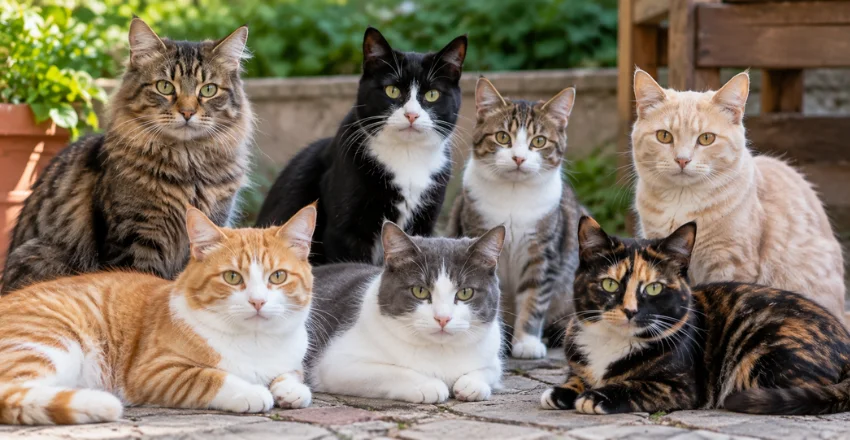
The word works grammatically like other collective nouns such as “herd,” “flock,” or “pack.” In U.S. writing, “a clowder of cats” is the clearest construction because the following phrase immediately tells readers what the unfamiliar noun means. Once the subject has been established, the clowder can stand alone later in the passage.
| Example | Natural use |
|---|---|
| “A clowder of cats rested in the afternoon sun.” | General description |
| “We found a clowder gathered near the barn.” | Narrative use |
| “The neighborhood cat colony receives regular care.” | Better for established community cats |
| “The mother cat was nursing a litter of kittens.” | Best for related kittens |
| “A glaring of cats watched from the fence.” | Playful or literary use |
You generally would not need to force the word into everyday conversation when “cats” or “several cats” sounds clearer. Collective nouns are most useful when the unusual vocabulary itself adds interest, as in trivia, educational material, creative writing, or animal features. Readers who enjoy this type of plain-English terminology can find more explanatory material in Contntra’s Education section. Contntra explains other everyday vocabulary in the same way, including a guide to what OMW means in a text message.
Which Cat Collective Noun Should You Use?
Choose “clowder” when you want the traditional all-purpose collective noun for adult cats. Choose “colony” when you are discussing an established population of community or free-roaming cats, and use “litter” when you mean kittens born together. Words such as “glaring,” “kindle,” and “destruction” are best treated as interesting traditional or playful alternatives rather than mandatory technical labels.
That distinction also makes your writing easier to understand. An animal-welfare article about managing an outdoor population will usually benefit from a colony, while a vocabulary article can introduce “clowder” because the word itself is the subject. The most unusual term isn’t automatically the most accurate for every situation.
Frequently Asked Questions
What is the official name for a group of cats?
The traditional collective noun is clowder. Dictionaries define it as a group or cluster of cats, making it the strongest answer for general vocabulary questions. In normal conversation, simply saying “several cats” is also completely understandable.
Clowder or glaring: which one is correct?
Both words occur as collective nouns for cats, but “clowder” is the more straightforward general answer. Glaring is much rarer and is often used humorously or to suggest cats staring suspiciously at one another. If you need one term for a quiz or definition, choose clowder.
What is a group of feral cats called?
A group of free-roaming cats living around the same location is commonly called a colony. U.S. animal-welfare organizations also increasingly use the broader term “community cats” for outdoor, unowned, free-roaming cats. These practical terms are generally more useful in welfare discussions than unusual traditional collective nouns.
What is a group of kittens called?
Kittens born together to the same mother are called a litter. “Kindle” is another traditional collective noun for kittens, but it is uncommon in everyday American English. Use “litter” when clarity is the priority and “kindle” when discussing unusual animal vocabulary.
Can you call a clowder a pride?
Normally, no. “Pride” is the familiar collective term associated with lions rather than domestic cats. For domestic cats, “clowder” is the traditional general term.
Can two cats be called a clowder?
Dictionary definitions do not establish an official minimum number of cats required for the word. In everyday speech, two animals are usually called a pair, while many popular references reserve “clowder” for three or more cats. Calling several cats a “clowder” is therefore safe, but there is no need to treat three as a scientifically fixed cutoff.
The Bottom Line
A group of cats is most traditionally called a “clowder,” and that is the answer most people are looking for when they search the phrase. Other names work in specific contexts: “colony” for community cats, litter for related kittens, and rarer words such as “glaring” or “kindle” for collective-noun trivia. The terminology is fun, but the cats themselves have far more flexible social relationships than any single label suggests.