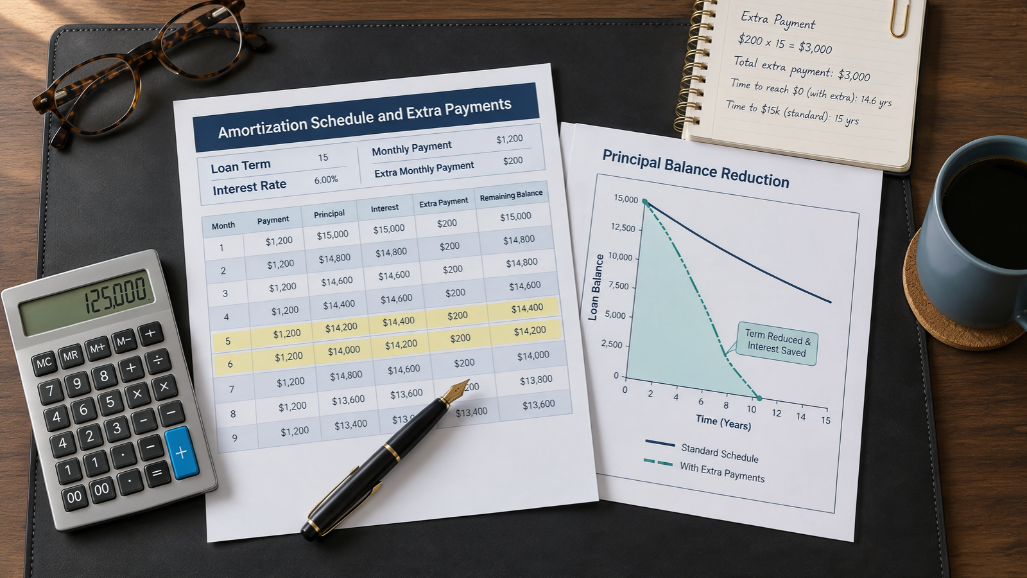
An amortization schedule and extra payments can show exactly how faster principal reduction changes a loan. Extra principal lowers your outstanding balance, so future interest charges are calculated on less money. That change can reduce total interest and move your final payment date forward.
Extra payments reduce a loan balance faster than the original schedule requires. That lower balance generally means less interest accrues during later payment periods. Your regular principal-and-interest payment may stay unchanged unless your lender approves a mortgage recast.
| Key point | What it means |
|---|---|
| Amortization | Each scheduled payment is divided between principal and interest |
| Extra principal | Money paid beyond the required amount and applied to principal |
| Main benefit | Lower future interest and potentially earlier payoff |
| Monthly payment | Usually stays the same unless the loan is formally recast |
| Best timing | Earlier extra payments generally affect more future interest periods |
| Important check | Confirm your servicer applies extra money to principal |
| Possible restriction | Review your loan documents for any prepayment penalty |
Key Takeaways
- Extra principal lowers the balance used for later interest calculations.
- Earlier extra payments generally create more interest savings than equally sized later payments.
- Monthly extra payments and lump sums can both shorten a loan.
- A large principal payment does not automatically lower your required monthly payment.
- A mortgage recast can sometimes reduce the required payment after a substantial principal reduction.
- U.S. borrowers should review loan terms before making major prepayments.
- Your servicer’s actual posting rules determine the final loan results.
How an Amortization Schedule and Extra Payments Work Together

An amortization schedule tracks how every scheduled payment affects a loan over time. Each row normally includes the payment amount, principal, interest, and remaining balance. The principal share usually grows as the outstanding balance becomes smaller.
With a typical fixed-rate mortgage, the principal-and-interest payment remains stable during the loan term. The allocation inside that payment changes from month to month. CFPB explains that early payments contain more interest because the outstanding balance is higher.
An extra principal payment changes the balance before later interest calculations occur. Future interest is then calculated using that reduced balance under the loan’s applicable terms. This is why an additional payment can affect many later rows rather than one month alone.
What Happens When You Make an Extra Principal Payment?
Assume you owe $300,000 on a fixed-rate mortgage and make an additional $5,000 principal payment. Your balance falls to roughly $295,000 after accounting for the applicable scheduled payment. Future interest calculations then begin from the lower outstanding principal.
The extra $5,000 does not normally replace your next required monthly payment. You continue making scheduled payments unless your lender changes the contractual payment amount. More of those later payments can reach principal because less interest accrues on the reduced balance.
Fannie Mae advises homeowners to tell their lender that extra money should be applied to principal. Paying interest ahead does not create the same principal-reduction benefit. Servicing procedures can differ, so borrowers should confirm how their own account handles additional funds.
Why Extra Payments Can Save Interest
Interest on an amortizing loan is tied to the outstanding balance. Reducing that balance ahead of schedule changes the base used for future interest calculations. Repeating the process can create a compounding payoff benefit across many remaining payment periods.
The timing matters because an early payment affects more future months. A $5,000 principal reduction during year three has much longer to influence interest than the same payment during year twenty-eight. The precise savings depend on your rate, remaining term, balance, and payment timing.
This effect explains why small recurring payments can become meaningful over a long mortgage. Fannie Mae’s mortgage calculator similarly models both one-time and monthly extra payments. It reports estimated interest savings and the reduction in repayment time.
Monthly Extra Payments vs. One-Time Lump Sums
Both strategies reduce principal, but they fit different household cash flows. Monthly extras create steady balance reductions without requiring a large amount of cash at once. Lump sums can produce a larger immediate reduction when savings, bonuses, or other funds become available.
| Strategy | Main advantage | Main drawback | Good fit for |
|---|---|---|---|
| Monthly extra payment | Consistent principal reduction | Raises monthly cash commitment | Stable monthly income |
| Annual extra payment | Flexible timing | Savings arrive less frequently | Annual bonuses or refunds |
| One-time lump sum | Immediate balance reduction | Uses significant cash at once | Large available cash reserve |
| Biweekly approach | Can increase yearly payment frequency | Servicer rules vary | Borrowers using supported programs |
Neither method is automatically better for every borrower. Cash reserves, other debts, interest rates, and financial goals should influence the decision. A homeowner with expensive credit-card debt may have a different priority than someone with strong emergency savings.
The safest comparison uses actual numbers from your loan. Model the original repayment path and then add each proposed extra payment. Compare the new payoff date, total interest, and remaining balance before committing your cash.
Example: How $200 Extra Each Month Changes a Loan
Consider a $300,000, 30-year fixed loan with a 6.5% interest rate. A standard principal-and-interest payment is about $1,896 each month. Adding $200 monthly raises the outgoing amount to about $2,096.
Current calculator examples using those inputs show the loan finishing in roughly 23 years instead of 30. They estimate interest savings above $100,000 (about $103,000 in our own check) under their assumptions. These figures illustrate the mathematics but should not be treated as a lender payoff quote.
Your results may differ because lenders can use different posting dates and rounding procedures. Your actual balance also depends on when additional money reaches principal. Use your mortgage statement or servicer portal when entering current loan information.
Does Paying Extra Lower Your Monthly Payment?
Making an extra payment usually reduces principal without changing your required monthly principal-and-interest payment. You keep making the contractual payment, which helps retire the loan sooner. This approach focuses on shortening repayment rather than lowering monthly obligations.
A mortgage recast works differently after a substantial principal reduction. The lender recalculates the required principal-and-interest payment using the new balance and remaining loan term. Fannie Mae describes a recast as recalculating payments after a significant principal curtailment.
Not every loan or servicer offers recasting. Minimum principal reductions, fees, eligibility rules, and loan types can vary. Contact your servicer before sending a large lump sum when a lower monthly payment is your main goal.
Should You Pay Extra Early or Later?
Paying extra principal earlier generally has a larger potential effect on total interest. The balance stays lower across more remaining payment periods. That gives the reduction more time to influence the loan’s future interest charges.
That mathematical advantage does not mean every spare dollar belongs in your mortgage. Fannie Mae recommends considering emergency savings before aggressively prepaying a home loan. It also suggests checking for any applicable prepayment penalties.
You should also compare the mortgage rate with other financial obligations. Higher-rate debt may deserve attention first because it costs more per borrowed dollar. Your tax situation, retirement contributions, and need for liquid savings can also affect the decision.
How to Build a Schedule With Extra Payments
You can model additional payments using a spreadsheet or a reliable loan calculator. Start with your current principal balance rather than the home’s original purchase price. Use the contractual interest rate, remaining loan term, and current principal-and-interest payment.
For each payment period, calculate interest using the applicable periodic rate and beginning balance. Subtract interest from the scheduled payment to determine normal principal. Then subtract any additional principal before calculating the next period’s balance.
A useful schedule should contain these columns:
- Payment number and date
- Beginning loan balance
- Scheduled payment
- Interest charged
- Scheduled principal
- Extra principal
- Ending balance
- Cumulative interest
- Estimated payoff date
The process should continue until the remaining balance reaches zero. The final payment will often be smaller than a normal scheduled payment. Recalculate every row after an extra payment because later principal and interest values have changed.
Check How Your Loan Servicer Applies Extra Money
Payment processing matters as much as the calculator formula. Fannie Mae servicing guidance requires identified additional principal payments on current eligible mortgages to be applied as principal curtailments. Your own loan may follow different investor or contractual rules.
Review the payment options in your servicer’s online portal before submitting money. Look for a field labeled “additional principal,” “principal only,” or similar wording. Check your next statement afterward to confirm the outstanding principal decreased correctly.
For broader money and business coverage, Contntra readers can browse the Business section. Readers following interest-rate developments may also find the site’s central bank coverage useful. Contrarian also explains practical banking access questions in its U.S. bank holiday guide.
Do Extra Mortgage Payments Have Prepayment Penalties?
Some U.S. mortgages can contain prepayment penalties, although many do not. CFPB says these provisions depend on the loan type and specific mortgage terms. The penalty should have been disclosed in the documents you received when closing.
CFPB notes that a penalty typically applies only when you pay off the entire balance within a set period, usually within 3 or 5 years of closing. Small additional principal amounts normally do not trigger such penalties. You should still review your note and ask your servicer before making a large payment.
Do not assume another homeowner’s loan has the same terms as yours. Loan programs, origination dates, and contractual language can differ. A quick document check prevents an avoidable surprise.
Extra Payments vs. Mortgage Recasting
Extra principal payments and recasting solve related but different problems. Extra payments mainly reduce the balance and can shorten the payoff period. A recast aims to lower the required monthly principal-and-interest payment after a substantial balance reduction.
| Feature | Extra principal without recast | Mortgage recast |
|---|---|---|
| Reduces balance | Yes | Yes |
| Can reduce total interest | Yes | Yes |
| Required payment automatically falls | Usually no | Yes, after approval |
| Loan term normally changes | Effective payoff becomes earlier | Original maturity generally remains |
| Interest rate changes | No | Usually no |
| Servicer approval needed | Usually not for ordinary extra principal | Yes |
A recast can make sense when monthly cash flow matters more than the earliest possible payoff. Continuing the old payment after a recast could still accelerate repayment if the servicer permits it. Ask for written terms before choosing either strategy.
Use the Schedule Before Sending Extra Cash
An amortization schedule and extra payments model turns an abstract payoff idea into measurable numbers. It can show how each extra dollar changes your balance, interest cost, and estimated payoff date. That information makes it easier to compare prepayment with other financial priorities.
Start with your current loan statement and test several realistic extra-payment amounts. Keep enough liquid savings for unexpected expenses, then verify how your servicer processes additional principal. For a large lump sum, also ask whether a recast would better match your goal.
The most useful strategy is one you can sustain without weakening the rest of your finances. Compare the savings, confirm your loan rules, and make extra payments only after understanding the tradeoffs. Your lender or servicer can provide the final account-specific figures.
Frequently Asked Questions
Can an amortization schedule and extra payments show my exact payoff date?
A calculator can provide a strong estimate when its inputs match your loan terms. Your servicer’s posting dates, rounding, and account rules can create differences. Use the servicer’s official payoff quote when you need an exact amount or date.
Is it better to make one extra mortgage payment each year?
One full additional payment each year can reduce principal faster than making scheduled payments alone. The exact savings depend on your rate, balance, remaining term, and payment timing. Dividing that amount across monthly principal payments may produce slightly different results.
Should I put extra money toward principal or interest?
Borrowers trying to reduce future interest normally want additional money applied to principal. Lower principal changes the balance used for later interest calculations. Fannie Mae specifically advises borrowers to identify extra mortgage funds as principal payments.
Does paying extra change escrow for taxes and insurance?
Extra principal payments concern the loan balance rather than property taxes or homeowners insurance. CFPB explains that many mortgage payments also contain separate amounts for taxes and insurance. Those escrow expenses can still change independently of your principal balance.
Can I stop making extra payments later?
Voluntary extra payments usually do not become part of the contractual monthly obligation. You can normally return to the scheduled payment when your budget changes. Confirm this treatment with your own servicer before establishing a recurring additional-payment instruction.