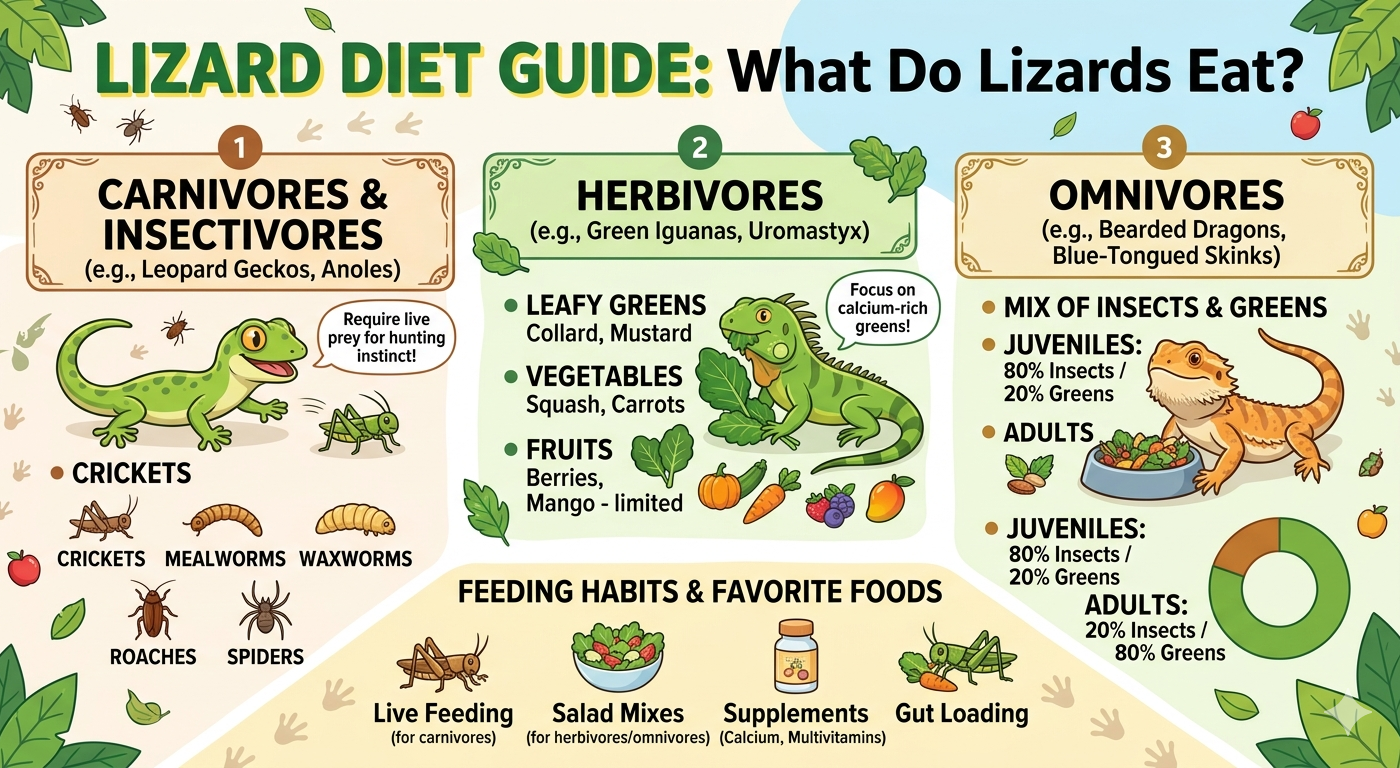
What do lizards eat? It depends entirely on the species in front of you. Some take only insects, some take only plants, and a few need both in a ratio that shifts as they age. Get the group wrong and you get a sick animal, not a fussy one.
This page splits the answer by species, because that is how the question usually arrives. Below is a feeding chart for the six lizards kept most often in American homes. After it come the supplement and lighting rules that decide whether the food does its job.
Lizard diet at a glance
| Species | Diet type | Staple foods | Adult feeding | Dust with calcium? |
|---|---|---|---|---|
| Bearded dragon | Omnivore, shifts with age | Collard and mustard greens, squash, dubia roaches, black soldier fly larvae | Greens daily, insects 3 to 4 times weekly | Yes |
| Leopard gecko | Obligate insectivore | Dubia roaches, crickets, black soldier fly larvae | Every 2 to 3 days | Yes |
| Crested gecko | Frugivore, mostly | Complete crested gecko diet powder mixed with water | 3 times weekly | Only for the insect meals |
| Blue-tongue skink | True omnivore | Greens, squash, berries, insects, snails, a little lean protein | Every 2 to 3 days | Yes |
| Green iguana | Strict herbivore | Collard, turnip and mustard greens, squash, hibiscus | Fresh salad daily | Yes |
| Veiled chameleon | Insectivore | Gut-loaded crickets, locusts, silkworms, hornworms | Every other day | Yes |
Key takeaways
- The species decides the shopping list. Salad in a leopard gecko tank is untouched clutter.
- Feeder insects are not a complete food. They are low in calcium, so they need gut loading and dusting.
- Calcium powder without UVB lighting is close to wasted, because the animal cannot process it.
- Metabolic bone disease is the outcome when both steps get skipped, and it is preventable.
- Fireflies, avocado, rhubarb and wild-caught bugs stay off the menu entirely.
Three feeding groups, and why the label decides everything
Any useful answer to what do lizards eat begins with three groups. Insectivores run on live prey and cannot digest plant fiber well. Herbivores ferment plant matter in an enlarged hindgut and have no use for meat. Omnivores sit between the two, and several of them move across that range as they grow.
Guessing the group is where new keepers go wrong. Scrambled eggs for a green iguana are not a generous treat, and kale offered to a leopard gecko is refused every time. Exotic pets punish generic care, the same way a hairless cat’s skin care has nothing in common with grooming a longhair.
Match the group first. Everything after that is detail.
What Do Lizards Eat, Species by Species
Bearded dragon: the ratio new owners get backward
Hatchlings and juveniles are heavily insect-driven, roughly 70 to 80 percent insects by volume, with greens offered every day whether or not they get eaten. That balance inverts as the animal matures.
Barboza and Bercier reviewed the evidence for Veterinary Clinics of North America: Exotic Animal Practice in 2024. Their guidance recommends at least 50 percent high-fiber vegetation for adults, dusted with pure calcium. Insects should stay under 50 percent of the diet, gut-loaded on an 8 percent calcium diet.
Keep feeding a three-year-old dragon like a hatchling and you get obesity and fatty liver. Cut the insects too early from a juvenile and you stunt it.
Leopard gecko: insects only, no salad
This is an obligate insectivore. It will not eat greens, and offering them achieves nothing. Dubia roaches, crickets and black soldier fly larvae make a solid staple rotation.
Waxworms and superworms are fatty, so treat them as a treat. A healthy adult takes food every two to three days, not daily.
Crested gecko: the powder really is the whole diet
Crested geckos are the exception that makes life easy. Commercial crested gecko diet powders are formulated as complete foods: mix with water, offer in a shallow dish, and replace it every 24 to 36 hours before it spoils.
Insects are optional enrichment rather than a requirement. If you offer them, dust them, because the powder is doing the mineral work the rest of the week.
Blue-tongue skink: the genuine omnivore
Roughly half plants and half animal matter suits most blue-tongues. Greens, squash and a little berry on the plant side; insects, snails and small amounts of lean protein on the other.
Many keepers use a high-meat wet dog food as part of the animal share. It works, provided the rest of the plate is not also protein.
Green iguana: plants only, and animal protein does real harm
Green iguanas are strict herbivores that ferment plant fiber in a modified hindgut. Feeding them insects, eggs or cat food pushes uric acid up and burdens the kidneys.
Hernandez-Divers published a review of green iguana nephrology in 2003. It reports that the initiating causes of kidney disease here are often inferred from poor husbandry and nutrition. Nutritional secondary hyperparathyroidism and chronic water deprivation both get named. Renal failure in a pet iguana is usually a slow husbandry failure, not bad luck.
Veiled chameleon: least forgiving of the six
Veiled chameleons eat gut-loaded crickets, locusts, silkworms and hornworms. They rarely drink from a standing bowl, so they need a dripper or a misting cycle to take water off leaves.
They also show supplement mistakes faster than any other common pet species, which is why the research below used them.
How often to feed, and how big each item should be
| Life stage | Insect-eating species | Plant-eating species |
|---|---|---|
| Hatchling to 3 months | 2 to 3 short feeds daily | Fresh chopped greens available all day |
| 3 to 12 months | Once daily | Fresh salad daily, replaced each morning |
| Adult, 12 months and up | Every 2 to 3 days | Fresh salad daily, portion controlled |
Then there is the prey width rule, which exotics vets repeat more than any other feeding rule. No food item should be wider than the space between the animal’s eyes. Anything wider is a choking and impaction risk, and impaction is a surgical problem rather than a wait-and-see one.
Measure by width, not by length. A long, slim hornworm is safer than a short, fat superworm of the same weight.
Gut loading, calcium dusting and UVB: the part most guides skip
Feeder insects are not balanced food, and this is where pet lizards are quietly lost. A 2026 study in the journal Animals states that house crickets have an inverted calcium to phosphorus ratio of 0.15 to 1 and hold under 0.3 percent calcium. A cricket straight from the tub is closer to junk food than to a meal.
Gut loading fixes part of that. You feed the insects a calcium-rich diet for 24 to 48 hours before they are offered, so the mineral arrives inside the prey rather than brushed on the outside.
Dusting is the second step. Shake the insects in a fine calcium powder immediately before feeding, so the coating is still there when they get eaten. Plain calcium at most feedings, calcium with vitamin D3 less often, and a multivitamin about weekly is the pattern most exotics vets teach.
Now the part that surprises people. Oonincx and colleagues ran a controlled trial on 84 juvenile bearded dragons. They measured plasma 25(OH)D3 concentrations 18 times higher in UVB-exposed animals than in animals given oral vitamin D3 at 6 months of age. Without UVB, much of the calcium you dust passes straight through.
Buy a UVB tube rated for the species, replace linear tubes every 12 months even if they still light up, and mount them with nothing between bulb and animal. Glass and most plastics block UVB completely.
Skip both steps and the outcome has a name: metabolic bone disease. Hoby and colleagues ran a six-month trial with 56 hatchling veiled chameleons, published in The Journal of Nutrition in 2010. The chameleons that received no supplementary calcium, vitamin A or cholecalciferol developed nutritional metabolic bone disease. Early signs are a rubbery jaw, bowed limbs, tremors and a sudden unwillingness to climb.
Foods that are unsafe, or simply a waste of a meal
One item deserves its own sentence. Knight and colleagues reported in the Journal of Chemical Ecology in 1999 that one firefly of the genus Photinus may suffice to kill a bearded dragon. African chameleons appear vulnerable too. The toxins are steroidal compounds called lucibufagins.
| Food | Why it is a problem |
|---|---|
| Fireflies and lightning bugs | Contain lucibufagins; documented as lethal to bearded dragons and chameleons |
| Avocado | Contains persin, the compound identified as the toxic principle in avocado leaves |
| Rhubarb leaves and stalks | High oxalic acid content; never appropriate for a reptile |
| Wild-caught insects | Carry pesticide residue and parasites, and you cannot tell a firefly from a beetle at dusk |
| Iceberg lettuce | Almost entirely water, so it fills the gut and delivers close to nothing |
| Spinach, beet greens, Swiss chard | High in oxalates, which bind calcium and block its absorption |
| Citrus fruit | Acidic, poorly tolerated, and absent from the natural diet of every species above |
Fruit is the most over-offered food in reptile keeping. For a crested gecko or a skink it is a small treat, for a strict insectivore it is nothing at all. Owners of other pets hit the same trap, which is why the question of whether cherries and dogs mix turns on the pit rather than the fruit.
What wild lizards eat, and why feeding them is unnecessary
Native species manage this without help. According to the Missouri Department of Conservation, the eastern collared lizard eats grasshoppers, beetles and moths, plus spiders, small snakes and other lizards. If a cat brings one indoors and it is unhurt, release it within 24 hours at the spot it came from.
A wild lizard finds more variety in a week than a keeper can offer in a month. Putting food out for one does nothing useful and can draw it toward cats, cars and treated lawns.
Many states restrict keeping native reptiles without a permit, so check your state wildlife agency before assuming a found animal is yours to keep.
When to see an exotics veterinarian
Take a sick or injured animal to a veterinarian who treats exotic pets. This page does not give doses, and no supplement fixes a fracture.
- A soft, rubbery or swollen jaw, or limbs that bow under the animal’s own weight
- Tremors, twitching, or weakness in the hind limbs
- Refusing food for more than a week in an adult, alongside visible weight loss
- Straining, or undigested prey appearing in the droppings
Droppings are an early warning system in every pet, which is why owners learn to read mucus in dog poop the same way. Photograph anything unusual before you clean it up.
Frequently asked questions
What do lizards eat most often in captivity?
Insects, for most pet species. Dubia roaches, crickets and black soldier fly larvae are the usual staples, with leafy greens and squash added for omnivores and fed exclusively to herbivores like the green iguana.
Can a pet lizard eat fruit every day?
No. Crested geckos get fruit through their formulated diet, and blue-tongue skinks can take a little berry a few times a week. Daily fruit for a bearded dragon or an iguana is too much sugar and too little calcium.
Does a lizard need a water bowl?
Most do, and it should be shallow and cleaned daily. Chameleons are the exception, because they drink moving droplets from leaves and usually ignore standing water entirely.
How long can a lizard go without eating?
A healthy adult can skip several days without harm, and some species slow right down in winter. Refusing food alongside weight loss, lethargy or a sunken look around the eyes is a veterinary matter, not a phase.
Is it safe to feed my lizard insects from the yard?
No. Wild insects carry pesticide residue and parasites, and fireflies are lethal to several species. Buy feeders from a supplier and gut-load them yourself.
Your next step tonight
Identify your species, then check two dates: the expiry on the calcium powder and the install date on the UVB bulb. Write that install date on the bulb in marker so the next replacement is not a guess. Those two dates shape your animal’s health more than any single food on the chart above.