A Toy Poodle may look like a tiny lap dog, but there is much more behind the carefully groomed curls. This compact Poodle combines high intelligence, an affectionate personality, low shedding, and enough energy to keep an owner involved every day. For the right household, that combination can make the breed an adaptable companion for apartments, houses, singles, couples, seniors, and families.
Size does not make the breed effortless to own, however. Because of its small frame, the breed needs regular coat maintenance, mental stimulation, consistent training, dental care, and protection from rough handling. Before bringing one home, it helps to understand what daily life with this breed actually involves rather than choosing one only for its appearance.
Quick answer: A Toy Poodle is the smallest AKC-recognized Poodle variety, standing 10 inches or under at the shoulder and typically weighing 4–6 pounds. These dogs are intelligent, affectionate, trainable, and low-shedding, but they need regular grooming, daily enrichment, careful handling, and responsible health screening from breeders.
Toy Poodle at a Glance
| Trait | Typical Toy |
|---|---|
| Height | 10 inches or under at the shoulder |
| Weight | About 4–6 pounds |
| Life expectancy | Roughly 10–18 years |
| Temperament | Intelligent, affectionate, playful, alert |
| Shedding | Very low |
| Grooming | High maintenance |
| Professional clipping | Commonly every 4–6 weeks |
| Exercise | Daily walk plus play and mental activity |
| Trainability | Very high |
| Best suited for | Engaged owners who want a small companion and can maintain its coat |
| AKC variety | Smallest of the three Poodle varieties |
The American Kennel Club’s official Poodle standard defines a Toy as a Poodle measuring no more than 10 inches at the highest point of the shoulder. AKC weight guidance places the variety at approximately 4–6 pounds, although an individual healthy dog’s ideal weight depends on build and veterinary assessment. Published breed guidance gives a relatively broad life-expectancy range of about 10–18 years.
What Is a Toy Poodle?
The Toy Poodle is the smallest size variety of the Poodle recognized by the American Kennel Club in the United States. Standard, Miniature, and Toy Poodles share the same essential characteristics, with size as the main distinction among the three varieties. That means a properly bred Toy should still display the active, intelligent, well-proportioned qualities described in the official Poodle standard.
Although Poodles are strongly associated with France, their earlier working history is connected with Germany, where larger Poodles developed as water-retrieving dogs. Breeders later bred smaller Poodles from larger varieties as companions, while retaining much of the breed’s intelligence and trainability. The result is a dog that may fit easily on a lap but often behaves more like a bright working dog than a decorative accessory.
Is a “Teacup Poodle” the Same Thing?
“Teacup Poodle” is not an additional Poodle size recognized in the AKC breed standard. In the United States, the recognized varieties are Standard, Miniature, and Toy, with Toy covering dogs that meet the variety’s size definition. Buyers should therefore treat labels such as “teacup,” “micro,” or similar terms as marketing descriptions rather than official AKC classifications.
How Big Does a Toy Poodle Get?
A full-grown Toy Poodle should stand no more than 10 inches at the shoulder under the AKC standard. Typical adult weight is around 4–6 pounds according to AKC breed-weight guidance, although healthy individuals can differ somewhat in body composition. The breed’s tiny footprint is one reason it works well in apartments and homes with limited floor space.
Small size also changes the way owners need to manage the dog. A Toy can be easier to carry and transport than a larger breed, but it is more vulnerable to accidental injury from falls, rough play, larger animals, or young children who have not learned gentle handling. Families should therefore think about safety and supervision as carefully as they think about convenience.
Temperament and Personality
Toy Poodles are widely described as intelligent, eager to please, playful, and strongly attached to their families. Their willingness to learn makes them responsive to positive-reinforcement training, while their curiosity means they usually benefit from activities that make them think rather than simply keeping them physically busy. A bored Poodle can turn its intelligence toward unwanted barking, jumping, or destructive behavior instead.
They can also be surprisingly confident for such small dogs. Proper early socialization helps a puppy become comfortable with visitors, household noises, handling, other dogs, grooming, and new environments, rather than becoming fearful or reactive. Temperament still varies between individuals, so meeting a puppy’s parents and discussing behavior with a breeder or rescue can provide useful context.
Do Toy Poodles Bark a Lot?
These dogs can be alert and vocal, particularly when they notice unfamiliar sounds, visitors, or activity outside the home. VCA characterizes barking as relatively high for the breed and notes that Poodles respond well to training, so barking shouldn’t be accepted as unavoidable. Rewarding quiet behavior, providing enough enrichment, and teaching calm responses to common triggers can make a significant difference.
Excessive vocalization may also stem from something beyond simple watchdog behavior. A dog that receives little stimulation, spends long periods isolated, or has learned that barking immediately brings attention may repeat the behavior because it works. Addressing the reason for barking is usually more productive than repeatedly correcting the noise after it starts.
Are Toy Poodles Good Family Dogs?
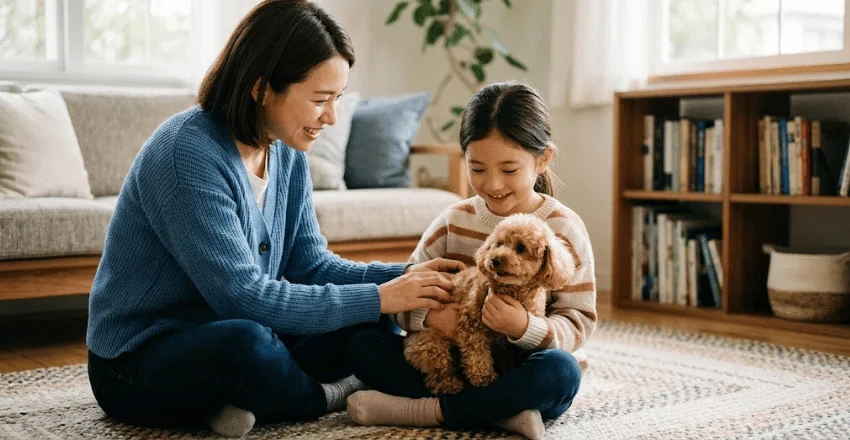
A well-socialized dog of this breed can be an affectionate family companion and often enjoys being included in everyday activities. Veterinary breed guidance describes them as generally gentle with children and other pets, but their very small bodies mean children need active adult supervision during interactions. A child who falls on, drops, grabs, or chases a four- or five-pound dog can injure it even without intending harm.
Households with older children who understand how to handle a small dog gently may find the match easier. Families with toddlers can still own a Toy successfully, but they need clear rules, protected resting areas, and consistent supervision rather than expecting the dog to tolerate unrestricted handling. The question is therefore not simply whether the breed “likes children,” but whether the household can keep both dog and child safe.
Are Toy Poodles Good Apartment Dogs?
Their compact size makes them highly practical for apartments, condominiums, and smaller homes. They don’t need a large yard to meet basic exercise needs, as long as they get a daily walk, indoor play, training, and safe opportunities to explore. Their low-shedding coat can also reduce loose hair left around furniture and flooring.
Apartment suitability still depends heavily on the owner’s routine. Barking, separation-related distress, and boredom can become more noticeable when neighbors share walls, so mental enrichment and calm-home training matter. A small dog that receives attention, exercise, and structure will generally adapt better than one that is expected to entertain itself all day. Owners weighing apartment life with a small companion can find further reading in Contntra pet care guides.
Exercise and Mental Stimulation
This variety doesn’t need the same physical workload as a large sporting breed, but it shouldn’t be treated as a dog that never needs exercise. VCA recommends a daily walk combined with play, while veterinary guidance also emphasizes interactive activities and mental stimulation. Short training sessions, retrieving small toys, food puzzles, scent games, and beginner agility-style activities can provide useful outlets for the breed’s active mind.
Because the dog is small, owners should judge exercise by the individual rather than by an arbitrary mileage target. Puppies, seniors, and dogs with orthopedic or respiratory problems may need different activity levels from healthy young adults. A veterinarian can help set appropriate limits when health or development creates uncertainty.
Training and Socialization
Trainability is one of the breed’s strongest advantages. They tend to be eager to engage with people and respond particularly well to reward-based instruction using praise, play, and appropriately sized treats. Beginning early with house training, recall, leash manners, handling, quiet behavior, and basic cues helps prevent a tiny puppy from developing habits that become harder to change later.
Grooming should be part of that training from puppyhood because it will remain part of the dog’s routine throughout life. The AKC recommends introducing Poodle puppies to brushing and grooming gradually so that handling becomes familiar rather than frightening. Teaching a puppy to tolerate its paws, face, ears, mouth, comb, brush, clippers, and grooming table can make future care considerably easier.
Grooming Requirements
The famous Poodle coat is both an advantage and a commitment. It sheds very little compared with many breeds, but its continuously growing curly hair can trap loose hair and form mats if you don’t brush it thoroughly. Dogs kept in longer styles may need daily brushing, while shorter clips can reduce home maintenance.
Professional grooming is commonly needed about every four to six weeks. Regular appointments generally include clipping, bathing, coat care, nail care, and other maintenance, depending on the groomer and the dog’s needs. Owners who plan to groom at home need suitable equipment and should learn safe techniques rather than assuming a small dog is automatically easy to clip.
Are Toy Poodles Hypoallergenic?
No dog is completely hypoallergenic. Poodles shed very little and may be better tolerated by some allergy-sensitive people, but allergens can still come from dander, saliva, and other biological material. Anyone with significant dog allergies should spend meaningful time around Poodles before deciding on long-term ownership.
Feeding and Weight Management
These dogs need a complete and balanced diet appropriate for their life stage, size, activity, and health. PetMD recommends foods meeting recognized nutritional standards and notes that calorie needs vary from one individual to another, so package directions are only a starting point rather than a perfect prescription. Because the dog is so small, even minor extras such as table scraps and training treats can make up a meaningful share of its daily calories.
Very young puppies require particular attention to feeding routines because small puppies can be vulnerable to low blood sugar. PetMD advises multiple small meals on a consistent schedule for puppies and recommends discussing individual feeding needs with a veterinarian. New owners should follow the breeder’s existing feeding schedule initially and obtain veterinary advice before making abrupt dietary changes.
Dental Care Matters More Than Many Owners Expect
Dental disease is especially important to watch in very small breeds. Plaque and tartar can progress to inflammation, infection, and damage around the teeth, making preventive oral care part of routine health maintenance rather than a cosmetic concern. PetMD recommends daily tooth brushing with dog-specific toothpaste and regular veterinary dental assessments.
Introducing tooth brushing while a puppy is young can make the habit easier to maintain. Owners should also have the mouth checked during regular veterinary visits and ask when professional dental cleaning is appropriate for the individual dog. Bad breath, difficulty chewing, bleeding gums, loose teeth, or visible oral pain warrant veterinary attention rather than simply being attributed to age.
Health and Lifespan
These dogs are relatively long-lived, with major U.S. breed resources commonly giving a broad expected range of about 10–18 years. Longevity varies with genetics, preventive healthcare, body condition, accidents, dental health, and individual disease history, so a published range cannot predict a particular dog’s lifespan. Regular veterinary care remains important even when a dog appears healthy.
Veterinary breed guidance discusses progressive retinal atrophy, patellar luxation, Legg-Calvé-Perthes disease, dental disease, ear infections, and tracheal collapse. These conditions do not mean every Toy will develop them, but they explain why responsible breeding and routine veterinary monitoring matter. Owners should contact a veterinarian when they notice persistent limping, vision changes, recurring ear problems, chronic coughing, oral pain, or other concerning symptoms.
Health Tests to Ask a Breeder About
The Poodle Club of America recommends specific screening for dogs used in Toy breeding programs. For the Toy variety, its current health guidance includes a DNA test for prcd-progressive retinal atrophy, an annual eye examination by a board-certified veterinary ophthalmologist, and evaluation for patellar luxation. Buyers can ask a breeder for documented results rather than relying only on statements that the parents are “vet checked” or “healthy.”
These breeding screenings do not guarantee a puppy will never become ill. They are tools designed to give breeders better information when making breeding decisions and to reduce avoidable inherited risk where testing is available. The Poodle Club of America health guidance is a useful starting point for U.S. buyers who want to understand what documentation to request.
Toy Poodle vs. Miniature Poodle vs. Standard Poodle
The three AKC Poodle varieties are separated primarily by height, not by being entirely different breeds. Toys stand 10 inches or under, Miniatures are over 10 inches and up to 15 inches, and Standards stand over 15 inches at the shoulder. All three retain the Poodle’s characteristic intelligence, coat, trainability, and general breed type.
| Variety | AKC Height | Typical AKC Weight Guidance | Practical Difference |
|---|---|---|---|
| Toy Poodle | 10 in. or under | 4–6 lb. | Most compact and physically delicate |
| Miniature Poodle | Over 10 to 15 in. | 10–15 lb. | Small but sturdier |
| Standard Poodle | Over 15 in. | About 40–70 lb. | Much larger and more athletic |
Choosing among the varieties should therefore involve more than deciding which photo looks cutest. A Toy is easier to carry and fits into small living spaces, but its fragile body demands extra care, while a Miniature or Standard may suit households wanting a sturdier companion. Lifestyle, exercise expectations, grooming commitment, children, travel, and available space should all influence the decision.
How Much Does a Toy Poodle Cost in the U.S.?
PetMD’s updated 2026 breed guide gives approximately $1,200–$3,000 as a breeder purchase-price range for a well-bred puppy, while noting that certain pedigrees may cost more. Actual prices vary widely by region, breeder, lineage, health testing, age, and other factors, so buyers should not assume the cheapest or most expensive puppy is the best choice. Adoption through a Poodle rescue or general animal shelter can provide another route to ownership.
The purchase price is only the beginning of the financial commitment. Professional grooming, veterinary visits, preventive medication, food, dental care, training, insurance, supplies, and emergencies can continue for well over a decade. Prospective owners should therefore evaluate the ongoing cost of responsible care rather than stretching their budget simply to buy the puppy.
How to Choose a Responsible Breeder
A responsible breeder should be comfortable discussing health, temperament, pedigree, socialization, and the breed’s strengths and limitations. The Poodle Club of America states that breeders should perform appropriate hereditary-disease testing and make proof of testing available to buyers. A breeder who avoids questions about health results, pushes an immediate sale, or focuses almost entirely on unusual size labels and appearance deserves additional scrutiny.
Ask to see health-testing documentation for both parents and understand what each result means before putting down a deposit. Discuss where puppies are raised, what early socialization they receive, when they go to new homes, what veterinary care has been completed, and what support the breeder offers afterward. AKC training guidance notes that Toy and Miniature Poodles may remain with their mothers until around 12 weeks because of their small size and developmental timeline.
Pros and Cons of Ownership
Advantages
- Highly intelligent and responsive to training.
- Very compact and suitable for smaller homes.
- Low-shedding coat.
- Affectionate and people-oriented.
- Long potential lifespan.
- Can enjoy obedience, tricks, scent games, and agility-style activities.
- Generally adaptable when properly socialized.
Challenges
- Coat requires frequent maintenance and professional grooming.
- Small body is vulnerable to accidental injury.
- Can become vocal when bored or poorly managed.
- May struggle when routinely left alone for extended periods.
- Needs regular mental stimulation despite its small size.
- Dental care requires consistent attention.
- Responsible breeder selection and health screening are important.
The ideal owner appreciates both sides of that list. Someone who wants an intelligent indoor companion and enjoys training may find the breed unusually rewarding, while someone looking for a nearly maintenance-free small dog may find the grooming and interaction requirements frustrating. Choosing based on daily compatibility is more important than choosing based on size or coat color.
Is a Toy Poodle Right for You?
The breed can be an excellent match if you want a small, engaged companion that stays close to household life. The breed is particularly appealing to people who enjoy teaching tricks, providing enrichment, keeping a dog professionally groomed, and having a companion that can live comfortably in a relatively small space. Owners should also be comfortable protecting such a small dog from rough handling and maintaining regular veterinary and dental care.
It may be a poorer fit if the dog will spend most of every day alone, if grooming costs or home coat care are unrealistic, or if household activity makes accidental injury likely. A larger Poodle variety or another breed may be easier for families that want a physically sturdier dog. The best choice fits the household for the dog’s entire life, not just puppyhood. Broader home and everyday-living articles are also available through the Lifestyle section of the site.
Frequently Asked Questions
How big is a full-grown Toy Poodle?
A full-grown Toy Poodle is 10 inches or under at the shoulder under the AKC breed standard. AKC weight guidance places most Toys at approximately 4–6 pounds. Still, assess individual healthy weight by body condition rather than by number alone.
How long do Toy Poodles live?
Major U.S. breed resources commonly list a life expectancy reaching into the teens, with AKC and PetMD guidance giving a broad range of approximately 10–18 years. Genetics, preventive medicine, dental health, nutrition, body condition, and accidents can all affect an individual dog’s lifespan. A long potential lifespan also means buyers should be prepared for a commitment that may last well over a decade.
Do Toy Poodles shed?
They shed very little compared with many other breeds. Their curly hair keeps growing and mats easily, so less shedding doesn’t mean less grooming. Regular brushing and clipping are essential parts of ownership.
Are Toy Poodles good with children?
They can be affectionate and gentle with children when properly socialized. Because the breed is extremely small, veterinarians recommend supervising interactions so a child does not accidentally injure the dog during play. Families should teach children to allow the dog to move away, rest undisturbed, and be handled gently.
Are Toy Poodles easy to train?
They are generally considered highly trainable because they are intelligent, responsive, and eager to interact with their owners. Positive reinforcement, short sessions, consistency, and early socialization tend to suit the breed well. Their intelligence also means training should include mental enrichment, not just physical exercise.
How often does a Toy Poodle need grooming?
Most Toys need professional clipping approximately every four to six weeks. Home brushing may be needed daily or close to daily when the coat is kept longer, because curly Poodle hair can mat quickly. Starting grooming exposure during puppyhood helps make coat care easier throughout the dog’s life.
Final Thoughts
A Toy Poodle offers much more than a small body and recognizable curly coat. It is an intelligent, affectionate, low-shedding companion that can thrive in many U.S. households when owners provide training, enrichment, grooming, preventive healthcare, and safe handling. Those requirements make the breed highly rewarding for engaged owners but less suitable for someone who wants a small dog with minimal maintenance.
Before choosing a puppy, compare breeders carefully and ask for documented health screening rather than relying on appearance or sales language. If adopting, discuss the individual dog’s behavior, medical history, grooming tolerance, and home needs with the rescue or shelter. A thoughtful decision at the beginning gives both owner and dog a much better chance of enjoying many years together.