A sunken driveway can create trip hazards, drainage problems, and rough transitions into a garage. Fortunately, homeowners can often raise concrete driveway sections without removing the entire slab. Slabjacking or polyurethane injection can restore settled panels when the concrete remains structurally sound.
Direct answer: A settled driveway can often be raised by drilling small holes and injecting grout or expanding polyurethane underneath the slab. The injected material fills empty spaces and gradually lifts the concrete. Raising works best when settlement is localized, and the slab has not developed severe structural cracking.
| Topic | Key Details |
|---|---|
| Main repair methods | Mudjacking and polyurethane foam injection |
| Best candidates | Solid slabs with localized settlement |
| Typical lifting cost | Roughly $3–$6 per square foot for mudjacking |
| Main cost factors | Area, lift height, void size, access, and location |
| Typical project time | Several hours to one day for many residential jobs |
| Replacement may be better | Severe cracks, crumbling concrete, or major structural failure |
| Main prevention step | Correct drainage and underlying soil problems |
Key Takeaways
- Concrete lifting can repair many sunken driveway sections without demolition.
- Mudjacking uses a cement-based slurry injected beneath the slab.
- Polyjacking uses expanding polyurethane foam through smaller injection holes.
- The underlying drainage or soil problem should also be corrected.
- Severely broken or deteriorated slabs usually need replacement.
- Professional lifting offers better control than improvised DIY methods.
Why Does a Concrete Driveway Sink?
Raise Concrete Driveway settlement starts underneath the slab rather than inside the concrete itself. Soil can consolidate, wash away, or lose support after years of moisture movement. Poor compaction during construction can also leave weak areas beneath the pavement.
Water is one of the most common contributors to lost support under slabs. Overflowing gutters or poorly positioned downspouts can saturate soil near paved surfaces. Contr’s gutter installation guide explains why directing roof runoff away from structures matters.
The Federal Highway Administration also identifies moisture and poor underlying support as causes of slab problems. Voids beneath concrete increase movement when vehicles pass over the surface. Continued movement can eventually lead to cracks, broken corners, and further settlement.
When Can You Raise Concrete Driveway Slabs?
You can usually raise concrete driveway panels when they have settled but remain mostly intact. Localized low areas are better candidates than slabs with widespread structural damage. Contractors inspect cracks, joints, drainage conditions, and the soil before recommending lifting.
The FHWA describes slabjacking as suitable for localized settlement where pavement remains generally free of major cracking. Material is pressure-injected below the slab until the surface returns toward the desired elevation. The same process also fills empty spaces that caused lost support.
Replacement becomes more reasonable when concrete is badly fractured or deteriorated. Lifting cannot reconnect pieces that have already separated into unstable sections. A professional evaluation can prevent spending money on a slab that cannot support a lasting repair.
Mudjacking vs. Polyurethane Foam Lifting
Both major lifting methods place material underneath settled concrete. The difference lies mainly in the injected material, hole size, weight, curing behavior, and cost. Neither method automatically solves the original reason the soil moved.
| Feature | Mudjacking | Polyurethane Foam |
|---|---|---|
| Material | Cement-based slurry | Expanding polyurethane |
| Injection holes | Usually larger | Usually smaller |
| Material weight | Heavier | Lightweight |
| Lift method | Hydraulic pressure | Foam expansion |
| Curing | Slower | Usually faster |
| Best use | Many standard residential slabs | Precise lifting and void filling |
| Typical cost | Often lower | Often higher |
Mudjacking
Mudjacking involves drilling holes through the slab and pumping cement-based grout beneath it. Pressure fills underlying voids before slowly raising the concrete. The holes are patched after the required elevation is reached.
The technique has been used for decades on roads, sidewalks, patios, and residential driveways. According to the FHWA, cement grout is a recognized material for slabjacking and stabilization. Proper injection control matters because excessive pressure can damage concrete.
Polyurethane Foam Injection
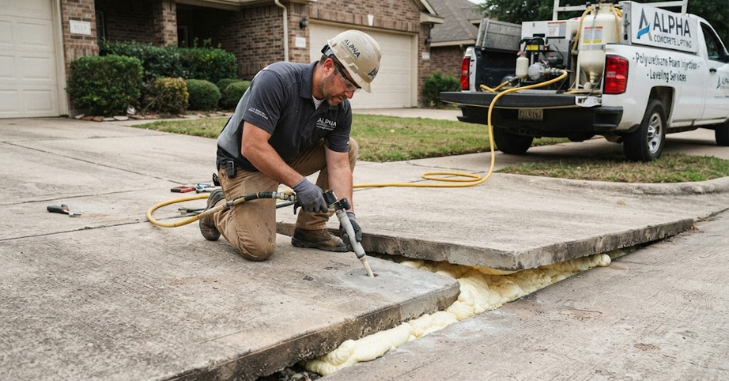
Polyurethane lifting uses expanding foam instead of a traditional cement slurry. Contractors inject the material through holes placed at selected points across the affected slab. Expansion beneath the concrete fills spaces and provides controlled upward movement.
FHWA technical material notes several advantages associated with polyurethane injection. The material is lightweight, expands after injection, and reaches strength quickly. Smaller injection points may also reduce the visible repair area.
How Professionals Raise a Sunken Driveway
Lifting may look simple after the equipment arrives, but controlling slab movement requires experience. Contractors must understand where support has been lost before choosing injection points. Incorrect lifting can create new cracks or unwanted pressure against nearby structures.
- Inspect the settlement. The contractor checks slab condition, cracks, joints, slope, and surrounding drainage.
- Find likely voids. Low areas and unstable sections help identify where support has disappeared.
- Choose injection points. Holes are positioned to provide controlled movement across the settled section.
- Drill through the slab. Hole size depends on the chosen lifting system and equipment.
- Inject material gradually. Grout or foam fills empty spaces and begins raising the slab.
- Monitor elevation. The contractor checks alignment continually to avoid excessive movement.
- Fill remaining voids. Additional material can stabilize areas that still lack support.
- Patch injection holes. The drilled openings are closed after lifting is finished.
- Correct drainage issues. Water should be redirected so settlement is less likely to return.
The FHWA describes slabjacking as controlled pressure insertion beneath concrete. The process raises depressed slabs toward adjacent elevations while restoring support. It also warns that the original cause must be addressed for better long-term results.
How Much Does It Cost to Raise a Driveway?
U.S. pricing varies considerably because every property has different soil, access, and settlement conditions. HomeGuide currently lists concrete lifting or mudjacking around $3 to $6 per square foot. Major driveway repair can cost substantially more when several sections need work.
Regional pricing shows why a national figure should only guide early budgeting. Reported slab-leveling rates vary between cities such as Charlotte, Minneapolis, Nashville, and Fort Lauderdale. Local labor costs and site conditions can move the final estimate.
Several factors can raise or lower your estimate.
- Total square footage requiring lifting.
- Depth and size of the underlying void.
- Amount of vertical correction required.
- Mudjacking versus polyurethane foam.
- Equipment access around the property.
- Number of injection points.
- Existing cracks or damaged joints.
- Local labor and material prices.
- Drainage repairs needed afterward.
A written estimate should describe the area being treated and the chosen material. Ask whether void filling is included after the slab reaches the target height. Also confirm whether joint sealing or drainage correction carries an additional charge.
Is Raising Concrete Better Than Replacing It?
Lifting usually makes sense when the existing concrete remains strong enough to reuse. You avoid demolition, hauling, forming, and pouring a completely new surface. That can reduce both project disruption and material consumption.
Replacement offers a better result when deterioration extends through much of the slab. Deep cracks, widespread spalling, major heaving, or multiple broken panels can limit lifting effectiveness. New concrete also allows contractors to rebuild an inadequate base before pouring.
Think of lifting as a structural correction rather than a cosmetic repair. It changes the slab elevation and restores support underneath the pavement. Surface resurfacing alone cannot correct an unsupported or sunken panel.
Can You Raise a Driveway Yourself?
Homeowners should be cautious about attempting full slab lifting themselves. Successful work requires pumps, injection materials, drilling equipment, and precise control over pressure. Raising one area too quickly can crack the slab or shift another section.
DIY work is better suited to fixing contributing conditions around the driveway. You can improve runoff control, seal appropriate joints, and repair nearby grading problems. A contractor’s guide to how much a yard of dirt costs can help with budgeting small grading projects.
Professional lifting is especially advisable near garage floors, foundations, utilities, or attached structures. Those locations leave less room for mistakes during elevation changes. Structural movement near a building may also justify evaluation by a qualified engineer.
How to Prevent the Driveway From Sinking Again
Start by managing water before it reaches the base beneath the driveway. Keep gutters clear and direct downspouts away from pavement edges. Standing water beside joints can encourage soil erosion and loss of support.
Look for soil gaps around the slab after storms or landscaping work. Areas that repeatedly wash out may need proper fill and compaction. The broader Contractor Home Improvement section includes additional maintenance guidance for protecting residential surfaces.
Sealing joints can also reduce water entry where the slab meets adjacent pavement. Yet sealing cannot compensate for major drainage defects underneath the surface. Correcting the cause of settlement is as important as restoring the slab height.
Signs You Should Call a Concrete Lifting Contractor
A small height difference can become more serious as settlement continues. Early evaluation may preserve a slab before cracking becomes extensive. Visible changes around the garage entrance often deserve prompt attention.
Consider professional inspection when you notice these signs.
- A noticeable step between adjoining driveway panels.
- Water pooling in a new low area.
- A slab sinking near the garage.
- Rocking or movement under vehicle weight.
- Growing gaps along slab edges.
- New cracks appearing after settlement.
- Drainage flowing toward the house.
- Trip hazards along driveway transitions.
Tell the contractor when the problem first appeared and whether it changes seasonally. Mention any plumbing leaks, drainage work, excavation, or recent landscaping nearby. Those details can help identify why support disappeared.
The Bottom Line
Raising settled concrete can save an otherwise usable driveway from premature replacement. The best candidates have localized settlement, manageable cracking, and enough structural strength to remain in service. Correcting drainage and soil issues helps protect the repair after lifting.
Before hiring a contractor, request an inspection and written estimate for the affected area. Ask which material will be injected and how remaining voids will be stabilized. A well-planned repair should address both the uneven surface and the reason it moved.
FAQs
What is the best way to raise concrete driveway sections?
The best method depends on slab condition, soil, access, and the amount of settlement. Mudjacking and polyurethane injection are the two common professional approaches. A contractor should inspect the slab before choosing between them.
How long does concrete lifting take?
Many residential lifting projects can be completed within several hours or one working day. Project size and the chosen repair method affect the exact schedule. Site preparation and additional drainage repairs can increase the total time.
How long does raised concrete last?
There is no universal lifespan because soil and drainage conditions differ between homes. A properly supported slab can remain stable for years when the original cause is corrected. Ongoing soil movement can cause new settlement even after successful lifting.
Will lifting fix cracks in my driveway?
Lifting can improve alignment, but it does not erase existing cracks. Contractors may seal or patch suitable cracks after the slab reaches its proper elevation. Severely broken concrete may require partial or complete replacement instead.
Is mudjacking cheaper than polyurethane foam?
Mudjacking often has a lower initial price than polyurethane injection. Foam may offer smaller holes and faster curing in many applications. Compare complete project estimates rather than judging the methods only by square-foot pricing.