Michael Douglas’s net worth is estimated at around $350 million. He earned it as both an Oscar-winning actor and a producer, starting with his Best Picture win for One Flew Over the Cuckoo’s Nest in 1975 and continuing through hits like Wall Street, Fatal Attraction and Basic Instinct, plus later Marvel and Netflix work. Producing profits, real estate and decades of residuals make up much of that fortune.
Born on September 25, 1944, Douglas is 82 years old in 2026 and has worked in film and television for more than 55 years. This guide covers where his money comes from, his key movies and TV shows, his awards, family background, personal life and the legacy that makes him one of Hollywood’s most durable stars.
| Category | Details |
|---|---|
| Full name | Michael Kirk Douglas |
| Date of birth | September 25, 1944 |
| Age | 82 (as of 2026) |
| Birthplace | New Brunswick, New Jersey, USA |
| Height | About 5 ft 10 in (1.78 m) |
| Profession | Actor, producer |
| Estimated net worth | Around $350 million (reported estimate) |
| Parents | Kirk Douglas and Diana Dill |
| Education | Choate School; University of California, Santa Barbara (BA, 1968) |
| Breakthrough | The Streets of San Francisco (TV, 1972–1976) |
| Oscars | Best Picture (1976, as producer); Best Actor for Wall Street (1988) |
| Spouse | Catherine Zeta-Jones (married 2000) |
| Children | Cameron, Dylan and Carys |
Michael Douglas Net Worth Breakdown

The roughly $350 million figure is the number most often quoted by celebrity wealth trackers. Like all celebrity net worth figures, it is an estimate built from reported salaries, known producing deals and property records, not a disclosed financial statement. What makes his fortune unusual is how much of it comes from ownership rather than acting fees.
Many actors earn a salary and walk away. Douglas, from the start of his film career, produced projects himself, which meant he shared in their profits. Cuckoo’s Nest was a low-budget film that became a major box office and awards success, and his producer’s share of it set him up financially before he was a leading man.
Main Sources of Income
| Income source | Examples | Notes |
|---|---|---|
| Producing | One Flew Over the Cuckoo’s Nest, The China Syndrome, Romancing the Stone, The Jewel of the Nile | Producer profits are often larger than acting fees on hit films |
| Film acting | Wall Street, Fatal Attraction, Basic Instinct, Disclosure, The Game, Traffic | Among the most bankable stars of the 1980s and 1990s |
| Television | The Streets of San Francisco, Behind the Candelabra, The Kominsky Method, Franklin | Prestige TV kept him in demand late in his career |
| Franchise work | Hank Pym in the Ant-Man films and Avengers: Endgame | Introduced him to a younger audience |
| Residuals and royalties | Streaming, broadcast and home video of his catalog | Steady income from decades of popular titles |
| Real estate | Homes reported in New York, Bermuda and Mallorca over the years | Bought, held and sold over long periods |
Endorsements have played a smaller role for him than for many stars. His wealth is mainly the result of owning a share of successful films and choosing roles that kept his salary near the top of the market for decades.
Early Life and Family Background
Michael Douglas was born in New Brunswick, New Jersey, the first son of actor Kirk Douglas and actress Diana Dill. Kirk, born Issur Danielovitch to Belarusian Jewish immigrants, became one of the biggest film stars of the 1950s and 1960s. Diana Dill came from a prominent Bermuda family, which is one reason Bermuda has stayed important to Michael throughout his life.
His parents divorced when he was young, and he spent much of his childhood with his mother on the East Coast while visiting his father’s film sets. Douglas has described himself as a shy, late-blooming child. Kirk was famously cautious about his son following him into acting, but Michael pursued it anyway.
Education
He attended Eaglebrook School and the Choate School before enrolling at the University of California, Santa Barbara, where he studied drama and graduated in 1968. He also studied acting in New York after college.
First Roles
His earliest screen credits include a small part in Cast a Giant Shadow (1966), which starred his father, and his first lead role in Hail, Hero! (1969). These films were not hits, but they gave him on-set experience and industry connections.
Career Journey and Rise to Fame
Douglas’s real breakthrough came on television. From 1972 to 1976, he co-starred with Karl Malden in the ABC police drama The Streets of San Francisco, earning three Emmy nominations. That show made him a familiar face across America, much as a long-running sports career in television can turn an athlete into a household name.
While still on the show, he took a big gamble: his father had owned the film rights to Ken Kesey’s novel One Flew Over the Cuckoo’s Nest for years, and Michael took over the project as producer. Released in 1975 with Jack Nicholson, it swept the top five Academy Awards, including Best Picture. At 31, Douglas was an Oscar-winning producer before he was a movie star.
He followed it by producing and co-starring in The China Syndrome (1979), then had his biggest commercial success to date with Romancing the Stone (1984), which he produced and starred in with Kathleen Turner. Its sequel, The Jewel of the Nile (1985), continued the run.
Michael Douglas Movies: The Peak Years

The late 1980s and 1990s made Douglas one of the most bankable actors in the world. He became known for playing powerful, flawed and often morally compromised men.
| Film | Year | Why it matters |
|---|---|---|
| Fatal Attraction | 1987 | Huge box office hit and cultural talking point |
| Wall Street | 1987 | Won him the Oscar for Best Actor as Gordon Gekko |
| The War of the Roses | 1989 | Dark comedy reuniting him with Kathleen Turner and Danny DeVito |
| Basic Instinct | 1992 | One of the biggest erotic thrillers ever made |
| Falling Down | 1993 | Acclaimed performance as a man pushed past breaking point |
| Disclosure | 1994 | Corporate thriller based on Michael Crichton’s novel |
| The American President | 1995 | Romantic political drama |
| The Game | 1997 | David Fincher thriller with a cult following |
| Wonder Boys | 2000 | Critically praised turn as a struggling professor |
| Traffic | 2000 | Ensemble drug-war drama that won four Oscars |
His most famous line, “Greed, for lack of a better word, is good,” from Wall Street, is still quoted in finance and business circles decades later.
Later Career Reinvention
In his 60s and 70s, Douglas found a new wave of success. He won an Emmy and a Golden Globe for playing Liberace in HBO’s Behind the Candelabra (2013). He joined the Marvel Cinematic Universe as scientist Hank Pym in Ant-Man (2015), returning in Ant-Man and the Wasp (2018), Avengers: Endgame (2019) and Ant-Man and the Wasp: Quantumania (2023). He then starred in Netflix’s The Kominsky Method (2018–2021), which won him another Golden Globe, and played Benjamin Franklin in the Apple TV+ series Franklin (2024).
Michael Douglas as a Producer
Producing is what separates Douglas from most actors of his generation. His early producing work shows a clear pattern:
- Find material with strong source writing, such as a novel or a timely real-world issue
2. Secure the rights early, often before the market sees the value
3. Attach top talent, even when that meant not casting himself in the lead
4. Keep a profit share rather than taking only a fee
That approach paid off with Cuckoo’s Nest and The China Syndrome, a nuclear-safety thriller released just days before the Three Mile Island accident in 1979, which made it look unusually prescient. His production company, Further Films, has continued to develop projects since the 1990s.
Awards and Achievements

- Academy Award for Best Picture, One Flew Over the Cuckoo’s Nest (as producer)
- Academy Award for Best Actor, Wall Street
- Golden Globes, including Best Actor for Wall Street, The Kominsky Method and Behind the Candelabra
- Primetime Emmy Award for Behind the Candelabra
- Cecil B. DeMille Award from the Hollywood Foreign Press Association (2004)
- AFI Life Achievement Award (2009)
- A star on the Hollywood Walk of Fame
He has also served as a United Nations Messenger of Peace since 1998, focusing on nuclear disarmament and the control of small arms.
Personal Life and Family
| Category | Details |
|---|---|
| First wife | Diandra Luker (married 1977, divorced 2000) |
| Second wife | Catherine Zeta-Jones (married 2000) |
| Children | Cameron (born 1978), Dylan (born 2000), Carys (born 2003) |
| Grandchildren | Two, through son Cameron |
| Shared birthday | He and Zeta-Jones were both born on September 25, 25 years apart |
| Health | Treated for stage four throat cancer in 2010 and has been cancer-free since |
His divorce from Diandra Luker was reported to involve a substantial settlement, and she later won a share of some of his earnings from projects linked to their marriage. Even so, his fortune continued to grow through his later career.
Luxury Lifestyle and Real Estate
Douglas has owned several high-end homes over the years, with properties reported in New York’s Hudson Valley, in Bermuda, where his mother’s family has roots, and on the Spanish island of Mallorca, which he has long loved. Compared with many Hollywood stars, he and Zeta-Jones keep a relatively private life, splitting time between the U.S. and Europe and spending much of it with family.
The Douglas Hollywood Dynasty
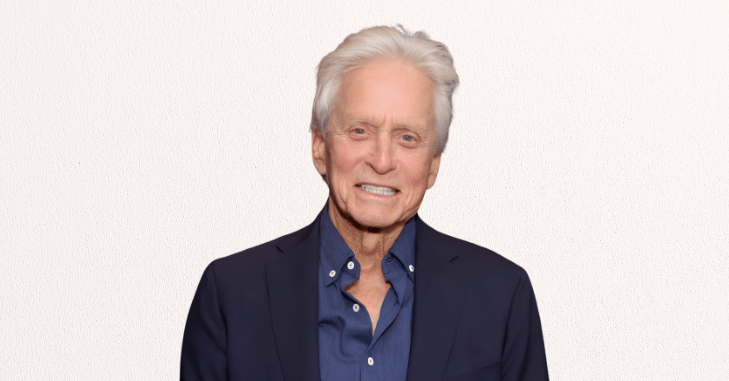
Few families have been as important to Hollywood as the Douglases. Kirk Douglas starred in classics like Spartacus and Paths of Glory and lived to 103, dying in 2020. Michael surpassed his father in awards and arguably in wealth, while building a career entirely his own. The two appeared together on screen in It Runs in the Family (2003), alongside Michael’s son Cameron.
What links them is longevity. Both remained active for decades, adapting to changing studios, audiences and formats rather than fading after a peak.
Career Challenges and Comebacks
Douglas has not had an uninterrupted run. Several films in the late 1990s and 2000s, such as Shining Through and The Sentinel, failed to match his earlier hits, and by the mid-2000s he was no longer the automatic choice for big studio thrillers. His personal life also made headlines, from a well-publicized stay in rehab in 1992 to his son Cameron’s legal troubles and prison sentence in the 2010s.
The biggest test came in 2010, when he announced a stage four throat cancer diagnosis just as Wall Street: Money Never Sleeps was being released. He completed treatment, returned to work, and within three years was winning awards for Behind the Candelabra. That comeback is a big reason his later career has been so financially strong: studios and streamers saw that he could still lead a project and draw critical praise.
For readers tracking celebrity finances, this is a useful pattern. A star’s net worth rarely moves in a straight line. Long gaps, flops and expensive divorces can slow it down, while a single well-chosen role can revive demand and fees for another decade.
How Residuals Keep Paying Him
Residuals are payments actors and other creatives receive when their work is reused, such as when a film is licensed to a streaming service, shown on cable or sold on digital platforms. For someone with a catalog as deep as Douglas’s, those payments add up. Titles like Wall Street, Basic Instinct and Romancing the Stone are regularly licensed to TV channels and streamers, and The Kominsky Method remains available on Netflix. Exact amounts are private, but residuals give him income that does not depend on new work.
What His Career Teaches About Building Wealth in Hollywood
- Ownership beats salary – his producer credits generated more lasting wealth than most acting fees
- Pick material early – securing rights to great stories before others saw their value
- Reinvent with age – he moved into prestige TV, Marvel and streaming rather than chasing the roles of his youth
- Protect the catalog – a deep library of popular films keeps paying residuals for decades
For more celebrity fortunes, read our guide to Zoe Saldana Net Worth or explore the full Entertainment category.
Bottom Line on Michael Douglas’s Net Worth
Michael Douglas’s estimated $350 million net worth is the result of an unusual double career: Oscar-winning producer and Oscar-winning actor. His early choice to own a piece of his projects, combined with peak-era hits and a smart late-career move into prestige TV and Marvel, made him one of the wealthiest actors of his generation. As with any celebrity, treat the exact number as a reported estimate.
FAQs
What is Michael Douglas’s net worth?
Michael Douglas’s net worth is estimated at around $350 million. Most of his wealth comes from producing hit films, acting fees from the 1980s and 1990s, television work and long-term real estate holdings.
How many Oscars has Michael Douglas won?
He has won two Academy Awards. The first was Best Picture as producer of One Flew Over the Cuckoo’s Nest (1975), and the second was Best Actor for playing Gordon Gekko in Wall Street (1987).
How old is Michael Douglas?
Michael Douglas was born on September 25, 1944, in New Brunswick, New Jersey. That makes him 82 years old in 2026.
Which film made Michael Douglas a movie star?
Romancing the Stone (1984), which he produced and starred in, turned him into a leading man. Fatal Attraction and Wall Street in 1987 then made him one of Hollywood’s biggest stars.
Who is Michael Douglas married to?
He has been married to Welsh actress Catherine Zeta-Jones since 2000. They have two children, Dylan and Carys, and he also has a son, Cameron, from his first marriage to Diandra Luker.
Is Michael Douglas related to Kirk Douglas?
Yes. He is the eldest son of actor Kirk Douglas and actress Diana Dill. Kirk Douglas died in 2020 at the age of 103.