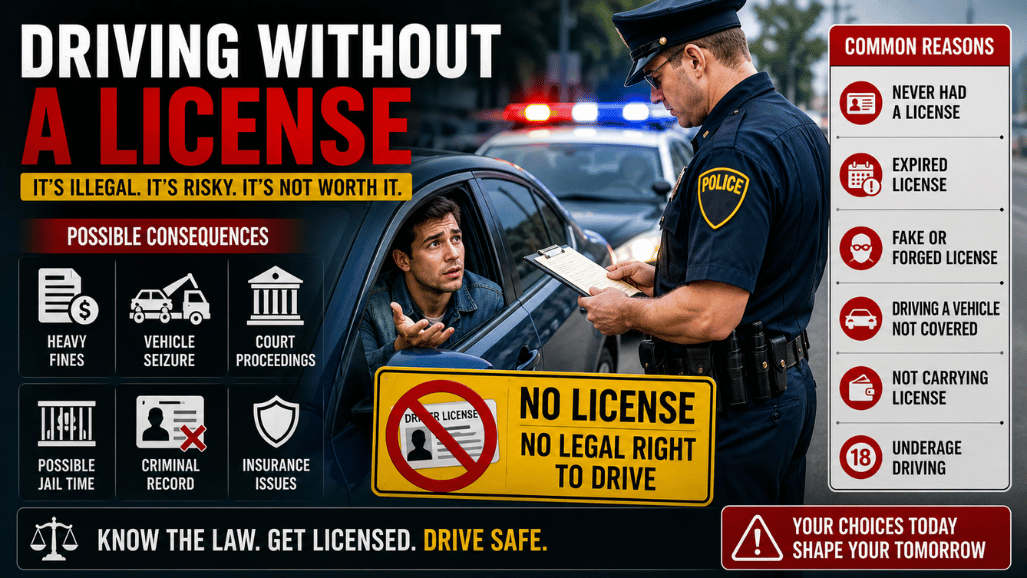
Driving without a license is four separate offenses, not one. Leaving the card at home is a paperwork problem, and courts routinely dismiss it. Driving on a suspension is a crime, with mandatory jail time in several states. The phrase is identical; the outcomes are not close.
Which of the four lands on your citation decides the fine, the jail exposure, whether a tow truck takes your car, and what your insurer does at renewal.
The four charges at a glance
| What the citation really alleges | How most states treat it | What usually happens |
|---|---|---|
| You are licensed, the card stayed at home | Correctable citation, sometimes a low-level infraction | Dismissed once you show the valid card to the clerk |
| You held one and it expired | Infraction or minor misdemeanor; higher with repeats | Fine, plus renewal at the DMV |
| You never held one | Misdemeanor in most states, fine-only in a few | Fine, community service, possible 30-day impound |
| A suspension or revocation is on your record | Misdemeanor with mandatory minimums; felony on repeats | Jail exposure, impound, an insurance filing |
Key takeaways
- There is no national penalty schedule. Every figure below comes from a named state statute.
- The forgotten-card version is correctable in California and most other states. Bring the card to court.
- Never holding one is a misdemeanor in most states. Ohio makes it a fine-only offense on a first charge.
- Driving on a suspension is the serious tier, and a DUI-based suspension is the worst version of it.
- Towing and storage often cost more than the fine itself.
Charges one and two: paperwork, not crime
California treats the forgotten card exactly as it sounds. Vehicle Code section 12951(a) tells a driver to carry the valid card while driving, and section 40303.5 puts that violation on the correctable list. Produce the card in court and the judge dismisses the charge. On a third or later charge the judge gets discretion instead.
Texas is cheaper still. Failing to carry the card under Transportation Code section 521.025 carries a fine of up to $200 on a first offense.
An expired credential sits one step up. Ohio splits the two situations inside a single statute, which almost no other page mentions. Under Ohio Revised Code 4510.12, a driver whose document merely expired commits a minor misdemeanor on a first violation with no prior convictions in three years. Two or more priors inside three years turns the same conduct into a first-degree misdemeanor.
Charge three: you never held one
This is the version most people picture, and it is a misdemeanor in most states. It is also where the state-by-state spread starts to get strange.
Ohio again writes the distinction into the text. A driver who never held one commits an unclassified misdemeanor under Revised Code 4510.12, and the statute says the court shall not impose a jail term. Fines reach $1,000, with up to 500 hours of community service. A second charge under the same section becomes a first-degree misdemeanor, and 180 days of jail exposure arrives with it.
New York is milder on paper. Vehicle and Traffic Law section 509 covers plain unlicensed operation. Section 1800 makes a Vehicle and Traffic Law violation a traffic infraction unless the legislature declared it a crime. A first infraction tops out at $150 or 15 days.
California is the odd one. Section 12500(a) requires a valid credential. The list of Vehicle Code misdemeanors at section 40000.11 does not name it. That same list does name the 14601 suspension sections. Section 40000.1 makes an unlisted violation an infraction, and section 40000.28 lifts it to a misdemeanor once a driver collects three Vehicle Code convictions in twelve months. Read together, those four sections explain why two unlicensed drivers in the same county can end up in very different courtrooms.
Charge four: suspended or revoked
Here the tone changes. A suspension means the state already made a decision about you, and driving anyway is the offense of ignoring it. Legislatures write mandatory minimums into these statutes precisely because the conduct is a second act.
According to New York Vehicle and Traffic Law section 511, third-degree aggravated unlicensed operation draws a fine of $200 to $500 and up to 30 days in jail. The second-degree version raises that to a minimum $500 fine plus 7 to 180 days. First degree is a Class E felony carrying $500 to $5,000.
Penalties by state: six statutes, six answers
Penalties for driving without a license are set state by state, so the table below names the statute for each figure. Another 44 states run their own schedules, and several change them every session. Check your own state code before you rely on any number.
| State | Statute | Classification, first offense | Exposure |
|---|---|---|---|
| California | Veh. Code 14601.2 (suspension from a DUI) | Misdemeanor | 10 days to 6 months jail; $300 to $1,000 |
| New York | VTL 511(1), third degree | Misdemeanor | Up to 30 days; $200 to $500 |
| Florida | Fla. Stat. 322.34(2)(a) | Second-degree misdemeanor | Up to 60 days; up to $500 |
| Texas | Transp. Code 521.457(e) | Class C misdemeanor | Fine up to $500, no jail |
| Illinois | 625 ILCS 5/6-303 | Class A misdemeanor | Under one year; up to $2,500 |
| Ohio | R.C. 4510.11 | First-degree misdemeanor | Up to 180 days, plus immobilization |
Florida sets the classification in section 322.34 and the numbers in sections 775.082 and 775.083. Texas sets the classification in section 521.457 and the numbers in Penal Code sections 12.21 through 12.23. Two statutes, one answer, which is why single-source summaries so often get the figure wrong.
What actually happens at the stop
Officers run your name and date of birth through the state driver record system before reaching your window. Status comes back in seconds: valid, expired, suspended, revoked, or no record at all. That result, not your explanation, shapes the next ten minutes.
A valid record and a missing card usually produces a correctable citation and a sign-here. A suspension changes the encounter. Texas law lets the charge climb from Class C to Class B if you were also uninsured, so the officer asks about insurance for a reason.
If the stop follows a collision, the civil claim runs on a separate track from the criminal one. Injured drivers often start by looking for an accident attorney the same week.
The tow truck is the part people forget
California authorizes a 30-day hold. Vehicle Code section 14602.6(a)(1) lets an officer seize the car of a driver who never held a credential. It reaches a driver caught during a suspension or revocation too. That vehicle then sits in storage for 30 days.
Thirty days is a storage bill, not a symbol. Texas publishes maximum rates for this, which makes the arithmetic checkable. According to Texas Occupations Code section 2303.155, a storage facility may charge up to $20 per day for a vehicle 25 feet or shorter. Add a $20 impoundment fee and a notification fee of up to $50. Those caps move every two years with inflation.
Run the numbers. Thirty days at the $20 cap is $600 in storage alone, before the tow itself and before the release fee. Drivers watching what the Illinois gas tax increase did to running costs will recognize the pattern: the headline number is rarely the whole bill.
Ohio ties the car to the record instead of the calendar. Revised Code 4510.11 orders 30-day immobilization with one prior in three years, 60 days with two, and criminal forfeiture of the vehicle with three or more.
What your insurer does next
Two things happen, and they are separate. Your carrier reprices or declines to renew, because a conviction lands on the motor vehicle record it buys. Then the state may demand a filing before it gives your driving privileges back.
Florida shows the size of that second step. According to Florida Statute 324.023, a driver convicted of DUI must carry $100,000 of bodily injury coverage per person and $300,000 per crash. Property damage coverage has to reach $50,000. Those limits hold for a minimum of three years. Those limits sit far above the ordinary Florida minimums, and the premium follows.
Let the filing lapse and the state pulls your driving privileges again, which puts you straight back into charge four.
How a second and third offense escalate
Repeat charges do not add fines. They change the category of the offense.
- Florida: a second conviction under section 322.34(2) becomes a first-degree misdemeanor. A third requires at least 10 days in jail, and a DUI-linked version becomes a third-degree felony.
- Texas: a prior conviction under section 521.457, or no insurance at the time, lifts the charge to a Class B misdemeanor and 180 days of exposure.
- Ohio: the second charge under 4510.12 turns a fine-only offense into a first-degree misdemeanor.
- New York: a prior within 18 months moves section 511 up to second degree and a minimum $500 fine.
That pattern holds nationally even where the numbers differ. Prosecutors treat the second charge as evidence that the first one taught nothing.
Driving without a license after a DUI suspension
This is the sharp end, and every state I checked writes a separate rule for it.
California requires jail. Section 14601.2(d) sets 10 days to 6 months of jail and a $300 to $1,000 fine for a first offense. A second within five years starts at 30 days and $500. Texas moves the charge to a Class B misdemeanor under section 521.457(f-1) whenever the suspension came from an intoxication offense.
Illinois goes furthest. According to 625 ILCS 5/6-303, a repeat charge carries a mandatory minimum of 30 days in jail where the revocation came from aggravated DUI. A revocation for reckless homicide triggers the same rule. Either way the offense becomes a felony, not a misdemeanor.
Unlicensed drivers and immigration status
Where you live decides whether this problem exists at all. The National Conference of State Legislatures counts 19 states plus the District of Columbia that issue driving credentials without regard to immigration status. California, Illinois, New York, Colorado and Minnesota are among them.
New York wrote it into the code. Vehicle and Traffic Law section 502(8)(b) says applicants for a non-commercial credential need not prove lawful presence. An applicant with no Social Security number may sign an affidavit instead. Any document issued that way is not federally compliant, so it carries a “Not for Federal Purposes” marking and will not board a domestic flight.
In the other 31 states there is no such route, and a driver without status falls into charge three by default. That single fact explains most of the geographic variation in unlicensed-driver prosecutions.
Your first court date, step by step
This article is general information, not legal advice. Anyone facing a charge should talk to an attorney admitted in their own state, and a searchable lawyer directory is a reasonable place to begin.
- Read the citation for the code section, not the officer’s shorthand. That number tells you which of the four charges you face.
- Confirm the date, the courthouse and whether your appearance is mandatory. Misdemeanors usually require you in person.
- Fix what you can fix first. Renew the credential, clear the underlying suspension, pay the reinstatement fee.
- Bring documents: proof of correction, the DMV printout of your current status, insurance.
- Ask the clerk about diversion or a traffic school option in that county. Availability varies by courthouse, not by state.
Nobody here will tell you how to plead. That decision belongs to you and your attorney, and it depends on facts a web page cannot see.
Frequently asked questions
Is driving without a license a misdemeanor?
Sometimes. Never holding one is a misdemeanor in most states, and driving during a suspension almost always is. Forgetting the card at home is normally a correctable citation, and an expired document is often an infraction or a minor misdemeanor.
Will I go to jail for a first offense?
Rarely, unless the suspension came from a DUI. California section 14601.2 sets a 10-day mandatory minimum in that situation. Ohio bars a jail term entirely for a first never-licensed charge.
Can the police impound my car?
Yes, in many states. California authorizes a 30-day hold under Vehicle Code 14602.6, and Ohio orders immobilization once you have a prior within three years.
What if I show a valid card in court later?
In California that usually ends it. Section 12951(a) directs the court to dismiss the charge when you produce the valid document, though the judge keeps discretion on a third or later charge.
Does this raise my insurance?
Almost always. A conviction reaches your motor vehicle record. After a DUI-related suspension, Florida requires $100,000 and $300,000 of bodily injury coverage plus $50,000 of property damage for three years.
Can I drive if I cannot prove immigration status?
In 19 states and the District of Columbia, yes, through a state credential that is not federally compliant. Everywhere else, no.
What to do this week
Pull your own driver record from your state DMV before anything else. It costs a few dollars. It tells you which of the four charges you face, which is the one thing the citation in your hand may not.