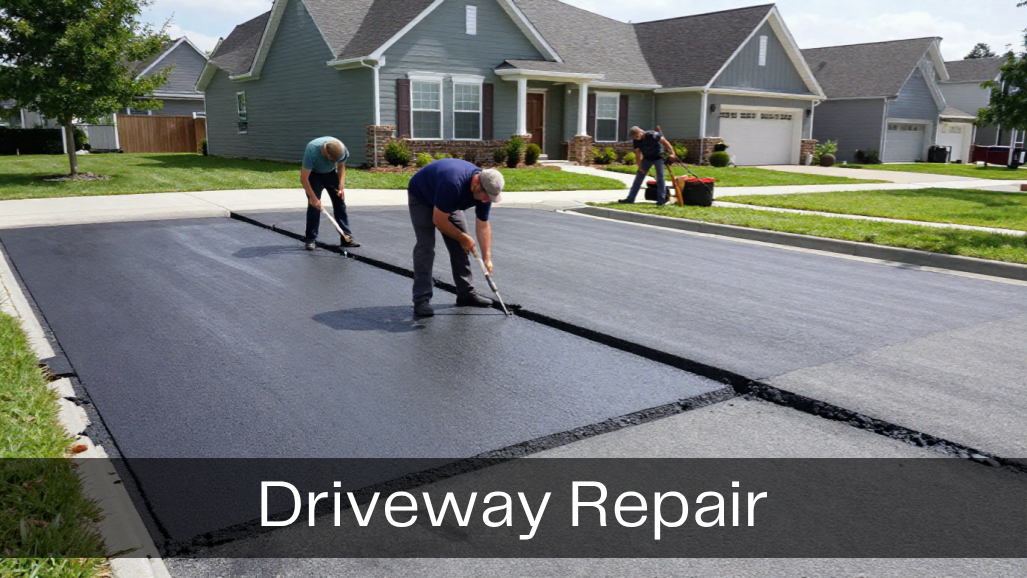
Most driveway repair work in 2026 falls between $300 and $2,500, and the national average sits near $1,200. Filling cracks costs $0.50 to $3.00 per linear foot. Patching costs $2 to $8 per square foot. Tearing out and replacing a two car surface costs $2,900 to $8,600.
Those are national figures, and your zip code moves them a lot. So does the thing most cost guides skip: what the damage says about the ground underneath.
| Job | Typical 2026 US cost | Basis |
|---|---|---|
| Crack filling | $0.50 to $3.00 | per linear foot of crack |
| Pothole patching | $100 to $400 | per visit, includes call-out fee |
| Asphalt resurfacing | $1 to $3 | per square foot |
| Concrete resurfacing | $3 to $7 | per square foot |
| Lifting a settled slab | $4 to $25 | per square foot, method dependent |
| Sealcoating | $1 to $2 | per square foot |
| Full replacement | $5 to $15 | per square foot, including removal |
| Reference size used here | 576 sq ft | 24 ft by 24 ft, a two car apron and run |
Key takeaways
- Diagnose first. The crack pattern tells you whether the base failed, and that fact swings the bill from hundreds into thousands.
- Interconnected cracks shaped like scales mean alligator cracking. No surface product fixes base failure.
- Replace when damage covers roughly a third of the area, when the base has failed, or when asphalt is past 20 years old.
- Sealer is not a repair. It does nothing for a crack wider than an eighth of an inch.
- Never buy paving from someone who knocked on your door with leftover material.
Read the damage before you price the fix
Every quote starts with an assumption about what lies under the surface. Contractors who guess low win the job and return in two years. Look at the pattern first.
| What you see | Likely cause | What it means | Typical fix and cost |
|---|---|---|---|
| Hairline cracks under 1/4 inch | Shrinkage, sun, aging | Cosmetic, but a water entry point | Pourable filler, $0.50 to $3 per linear foot |
| Cracks over 1/4 inch | Freeze-thaw, roots, slab movement | Water already reaching the base | Rout and fill, $2 to $5 per sq ft |
| Alligator cracking, interconnected scales | The base has failed | Surface work will not hold | Full depth patch or replacement, $5 to $15 per sq ft |
| Potholes | Water washed the base out through a crack | Local base loss, spreading | Saw-cut patch $4 to $12 per sq ft, or $100 to $400 per hole |
| Crumbling edges | No shoulder support, tires on the edge | Structural but local | Edge rebuild plus shoulder, $3 to $8 per sq ft |
| Settling or sinking near the apron | Poor compaction, washed-out fill | Slab sound, soil is not | Mudjacking $4 to $9 per sq ft, foam $8 to $25 |
| Heaving, a raised lip at a joint | Frost, or a root underneath | Never cosmetic | Grinding, root removal, or slab swap |
| Spalling and scaling on concrete | De-icing salt, weak finishing | Top layer failing, base fine | Resurfacing, $3 to $7 per sq ft |
| Oil staining | Leaks parked in one spot | Cosmetic on concrete, softening on asphalt | Degreaser, patch if the binder softened |
Why alligator cracking is the expensive one
Asphalt is flexible. It carries no weight on its own, and instead spreads the load onto a compacted stone base, which passes it to the soil below.
Lose that support and the surface flexes under every car. Flexing metal fatigues. Asphalt does the same, and the result is a web of interconnected cracks shaped like reptile skin, showing up in the wheel tracks first.
Patch it and the patch fails, because the problem is six inches down. A 100 square foot patch might run $400. Once fatigue cracking covers most of the area, you are buying removal and replacement, roughly $2,900 to $8,600 on a 576 square foot two car surface. Reading the pattern right is the most valuable ten seconds of this project.
Settling is a drainage problem wearing a concrete costume
A slab that dropped an inch at the apron did not shrink. The fill under it washed away or compressed, almost always because water has run to the same spot for years.
So check where roof water lands before you pay anyone to lift anything. A downspout dumping beside the slab will undo a $2,500 lift in a few seasons, which is why proper gutter installation and downspout extensions belong in the same budget. Water first. Concrete second.
Repair or replace: the one-third rule
Here is the rule contractors use in their heads and rarely say out loud. Replace the surface if any one of these is true.
- Damage covers roughly a third or more of the total area.
- Alligator cracking appears across a broad section, not just one wheel track.
- Asphalt has passed about 20 years, or concrete has passed about 30.
- The same potholes keep reopening in the same spot after two or more patches.
- Water now drains toward the garage instead of away from it.
Repair when the damage is local, the surrounding area is firm underfoot, and rain still sheds toward the street. That covers most homeowners.
Run the math and the third holds up. Patching 100 square feet of a 576 square foot asphalt surface at $3 per square foot costs about $300, or roughly a tenth of replacement. Patching 190 square feet costs closer to $600. You are then paying a fifth of replacement price for a surface that keeps failing.
Bottom line: below the one-third mark, we recommend patching and sealing. Between a third and a half, resurface if the base is firm. Above that, replace. Fatigue cracking overrides all of it.
What driveway repair costs in 2026 by material
Material changes every line item, not just the replacement number. The figures below are national averages for 2026. Quotes in the Northeast or on the West Coast routinely run 20% to 40% higher.
| Job | Asphalt | Concrete | Gravel | Pavers |
|---|---|---|---|---|
| Crack filling, per linear foot | $0.50 to $3 | $0.50 to $3 | Not applicable | Re-sand joints instead |
| Patching, per square foot | $2 to $5 | $3 to $8 | Regrade, $1 to $3 | Reset by hand |
| Resurfacing, per square foot | $1 to $3 | $3 to $7 | Add 2 in of stone | Not applicable |
| Lifting a settled area, per square foot | Not applicable | $4 to $9 mudjack, $8 to $25 foam | Regrade and compact | Lift and re-bed |
| Replacement, 576 sq ft, with removal | $2,900 to $6,900 | $3,500 to $8,600 | $600 to $1,700 | $5,800 to $17,300 |
| Service life | 15 to 30 years | 30 to 40 years | Indefinite with topping up | 25 to 50 years |
Two line items surprise people. Demolition and haul-away alone adds $2 to $6 per square foot, which is why a replacement quote can double a repair quote before new material arrives. Gravel is cheapest to own and regraded most often.
Base work is the other hidden number. A crew rebuilding the base sells you stone and compaction by the cubic yard. Knowing how much a yard of dirt and fill covers makes that line readable.
DIY material costs against a real quote
Should I do this myself? Some of it is worth it, some is a trap. Materials cost far less than labor, so the tool list decides the answer.
- Crack filler. A gallon covers plenty of linear feet for under $30. Pros charge $0.50 to $3 per foot, mostly labor. Clear win.
- Cold patch for potholes. Bags run $8 to $20 for 50 pounds and cover 5 to 7 square feet at one inch deep. Two bags fill a typical hole for about $30. A pro charges $100 to $400, since a $100 to $250 call-out fee lands before any material.
- Concrete resurfacer. Bags run $20 to $40 for 40 pounds. Coating 576 square feet takes 15 to 25 bags, so $400 to $900 against $1,700 to $4,000 for a pro overlay. The savings are real, the finish rarely is.
- Sealer. A five gallon pail covers 250 to 500 square feet, so two handle a two car surface. Roughly $60 to $150 against $400 to $800 for a crew.
Leave saw-cut patches, slab lifting and base work to a contractor. Renting the saw, compactor and pump costs more than the labor you saved.
Timing, temperature and cure times
Timing matters more here than in most outdoor projects, because crews lay asphalt hot and must compact it before it cools. They want ground and air temperatures above roughly 50°F and rising for hot mix. Below that the mat stiffens before the roller closes it, leaving a porous surface that drinks water. Crack filler and sealer share the 50°F floor, plus 24 dry hours afterward.
Cure times are where people ruin new work:
- New asphalt: stay off it 24 to 72 hours, keep heavy trucks off for 30 days, and do not seal it for at least 90 days.
- New concrete: walk on it after 24 to 48 hours, park on it after 7 days, full design strength at 28 days.
- Patches and overlays: follow the bag, usually 24 hours before foot traffic and 72 before a car.
- Cold patch: compact it, drive slowly, expect to top it up once.
In freezing climates the calendar does the damage. Water seeping into a crack expands about 9% when it freezes, prying the gap wider on every cycle. Fill a crack in September and it stays a crack. Leave it open through a Minnesota winter and it is a pothole by April. Skip rock salt on concrete under a year old, which accelerates scaling.
Sealcoating, honestly
Sealer gets oversold harder than anything else in this trade.
What it does: block UV, water and fuel from reaching the asphalt binder, and turn a gray surface black again. On sound asphalt that genuinely stretches service life.
What it does not do: fill a crack wider than about an eighth of an inch, fix a pothole, add structural strength, or save a failed base. Sealing over alligator cracking hides the diagnosis and changes nothing.
Frequency is where the sales pitch breaks down. Every two to ten years is the honest range, set by product, sun and traffic. Annual sealing is not maintenance, and stacked coats peel in sheets. Concrete wants a penetrating siloxane sealer instead.
Hiring: what a real quote itemizes
An estimate worth trusting names quantities, not a lump sum. Get it in writing before you sign.
- Measured square footage, taken on site.
- Thickness in inches: binder and surface course for asphalt, slab depth and mix strength for concrete, typically 4 inches at 4,000 psi.
- Base scope: excavation depth, stone type, and compacted depth.
- Reinforcement and control joint spacing on concrete.
- Slope and where the water goes.
- Demolition and haul-away, priced separately.
- Warranty length, license number, and a certificate of insurance.
- Payment schedule with a modest deposit, never the full amount up front.
Get three and compare line by line. The habits that help you screen local gutter companies near you apply here, since paving draws the same mix of solid regional crews and one-season operators.
The leftover asphalt scam, and your three day out
Paving fraud follows a script, and it runs every spring and summer. Someone knocks, claims a crew finished a job nearby, and offers the leftover material cheap, today only. There is no leftover material. You get a skim of cold mix over dirt, and the crew is gone before the first rain.
The warning signs are consistent:
- An unsolicited knock, high pressure, and a price good only today.
- A verbal lump sum with no measurements, thickness or written contract.
- Cash demanded up front, or a trip to your bank.
- Out-of-state plates, magnetic signs on the truck, no license number.
- No physical business address you can look up.
If you already signed something at your door, you have a way out. According to the Federal Trade Commission’s Cooling-Off Rule, a sale of $25 or more made at your home can be canceled for a full refund. The right runs until midnight of the third business day after the sale. Send the cancellation in writing, keep proof of the date, and report the crew to your state attorney general.
FAQ
How much does driveway repair cost per square foot?
Asphalt patching runs $2 to $5 per square foot and concrete patching $3 to $8. Resurfacing runs $1 to $3 for asphalt and $3 to $7 for concrete. Full replacement including demolition runs $5 to $15, by material.
Is it cheaper to lift a sunken slab or replace it?
Lifting wins when the slab itself is intact. Mudjacking costs $4 to $9 per square foot and polyurethane foam $8 to $25, against $6 to $15 to tear out and repour. Foam cures in about 15 minutes, so you park on it the same day.
What size crack is too big to simply fill?
Anything past about half an inch wide, or any crack with a vertical lip. A lip means the sections move independently, so filler tears apart within a season. Those need routing, patching or a slab swap.
How long should a patched pothole last?
A saw-cut, compacted hot patch should last 5 to 10 years. A cold patch dropped into an unprepared hole often lasts one winter. If the same hole reopens twice, stop patching. The base beneath it is gone.
Do I need to sealcoat every year?
No. Every two to ten years covers almost every situation, and annual coats build up and peel. Wait at least 90 days to seal new asphalt, then judge by color and texture rather than the calendar.
Your next step
Walk the surface this week with a tape measure and a phone. Photograph each crack pattern, note the widths, measure the total area. Then ask three licensed local contractors for itemized written quotes on the same scope.
With a diagnosis in hand you stop shopping on price alone. You will know whether you are buying a $300 afternoon or a $6,000 rebuild. Nobody at your door decides that for you.