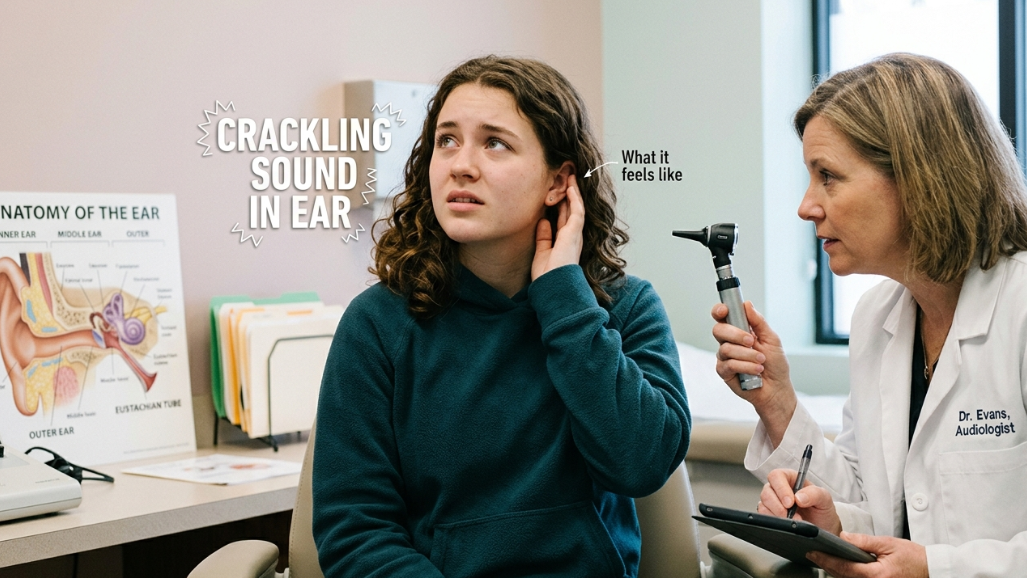
A crackling sound in the ear is usually mechanical noise, not damage. What matters is the trigger. Swallowing points one way, chewing points another, and a crackle that keeps exact time with your pulse points somewhere else entirely.
So this page is sorted by trigger rather than by a list of conditions. Find the row that matches what you hear, read that section, and stop there. This is information and not a diagnosis. Anything that persists, worsens or arrives with hearing loss needs a clinician.
Match your pattern to a likely cause
| What you hear | When it happens | Likely cause | Usual course |
|---|---|---|---|
| One or two wet clicks. | Only when swallowing, yawning or blowing your nose. | Eustachian tube dysfunction. | Days to a few weeks. |
| Dull crackling with muffled hearing. | Constant, and it began with a cold. | Fluid behind the eardrum. | Often clears inside three months. |
| Sharp clicking or grating. | Only when chewing, clenching or opening wide. | Jaw joint noise, not the middle ear. | Rises and falls with jaw strain. |
| Rapid flutter, like a moth in a lampshade. | Random, and loudest in a silent room. | Muscle spasm behind the eardrum. | Arrives in bursts, then settles. |
| Your own breathing and voice, amplified. | Worse standing, better lying down. | Patulous eustachian tube. | Tracks weight and hydration. |
| Dry rustling or scratching. | Shifts when you move your jaw. | Earwax touching the eardrum. | Gone once the wax clears. |
| Whooshing that pulses with your heartbeat. | Constant, and it matches your pulse. | Blood flow, not machinery. | Needs assessment, see red flags. |
Key takeaways
- Trigger beats symptom lists. What sets the noise off narrows the cause faster than any checklist.
- Crackling tied to swallowing is a pressure problem. Crackling tied to chewing is a joint problem.
- Noise that started with a cold and stayed usually means fluid, and fluid takes weeks to drain.
- Pulsing in time with your heartbeat is the one pattern to get looked at soon.
- Sudden hearing loss on one side is an emergency, not a wait-and-see symptom.
- Cotton swabs and ear candles make things worse. Guidelines advise against both.
Start with the trigger, not the list of causes
Behind your eardrum sits a sealed pocket of air. It stays quiet while three things hold true. The pressure inside matches the pressure outside, no fluid is sloshing around, and the jaw joint a few millimeters in front of the canal behaves itself.
Nearly every crackling sound in the ear traces back to one of those three.
Two questions do most of the sorting. What sets the noise off? And does it stop the moment the trigger stops?
Crackling only when you swallow, yawn or pop your ears
The eustachian tube runs from that pocket down to the back of your nose. Most of the day it sits closed. Small muscles in your palate yank it open for a fraction of a second whenever you swallow or yawn. That click you hear is damp tissue peeling apart.
Swollen lining changes that. A cold, allergies, sinus inflammation or reflux thickens the walls, so the tube opens unevenly and in stages. One clean pop becomes a run of small crackles, often with a plugged feeling and a voice that sounds odd inside your head.
This is the most common answer by a wide margin. A 2019 study in JAMA Otolaryngology-Head and Neck Surgery analyzed national survey data from 5,620 adults. It estimated that 4.61% of US adults have eustachian tube dysfunction, roughly 11 million people.
What usually helps:
- Chewing gum or sipping through a straw during descent.
- A gentle swallow with your nostrils pinched, never a forceful blow.
- Steam, saline nasal rinses, and treating whatever allergy is driving the swelling.
Muffled crackling that stayed after a cold
If the noise arrived with a head cold a month ago and hearing still sounds walled off, suspect fluid. Thin liquid collects behind an intact eardrum. Bubbles shift through it whenever the tube opens, which produces a soft wet crackle and a real drop in clarity.
Time does most of the work here. The American Academy of Otolaryngology-Head and Neck Surgery Foundation publishes the 2016 guideline on otitis media with effusion. It reports that about 75% of effusions clear within three months after an acute infection, falling to 56% when the start date is unknown.
Those same guidelines make a strong recommendation against antihistamines and decongestants, because neither clears the fluid. Pharmacy shelves suggest otherwise. Ask for a hearing test instead if the muffling drags past three months.
Clicking that follows your jaw, not your ears
Your temporomandibular joint sits directly in front of the canal opening. Bone conducts sound well, so a joint that clicks feels like it is clicking inside your head.
It is not.
Here is a self-test that separates the two in about ten seconds. Rest a fingertip in the soft hollow just in front of the canal. Open your mouth slowly and wide. If the click lands under your finger at the exact moment you hear it, the joint is the source and your ears are only the speaker.
Jaw disorders are common. The National Institute of Dental and Craniofacial Research reports that about 11 to 12 million US adults have pain in the temporomandibular joint region. Grinding at night, chewing gum, tough steak and long dental appointments all aggravate it.
Soft food for two weeks, heat, and a custom night guard from a dentist usually settle the noise. Painless clicking on its own needs no treatment at all.
A fast flutter you only notice in silence
Two tiny muscles behind the eardrum tense reflexively to protect you from loud sound. Sometimes they misfire and contract rhythmically, several times a second. You hear a flutter, thump or rapid crackle with no external cause. Clinicians call it middle ear myoclonus.
Its signature is distinctive:
- Fast and irregular, and never in step with your pulse.
- Often starts after a loud event or a stretch of bad sleep.
- Vanishes the second a room gets noisy enough to mask it.
- Sometimes audible to a clinician through a stethoscope.
Most cases fade on their own. If loud rooms set it off, filtered earplugs are a sensible first move, and our breakdown of how Loop earplugs filter sound covers which model suits which situation. Stubborn cases go to an ENT for muscle relaxants or, rarely, tendon surgery.
Hearing your own breathing inside your head
This is the pattern that gets misdiagnosed most often. A patulous eustachian tube is the opposite of a blocked one. It stays propped open instead of sealing shut, so air moves through it with every breath.
You hear yourself breathing. Your own voice booms. That symptom has a name: autophony.
Posture is the giveaway. Symptoms ease when you lie flat or drop your head between your knees, because venous blood pools in the surrounding tissue and swells the tube closed. They return when you stand.
Rapid weight loss, dehydration, pregnancy and hard exercise all trigger it. That distinction matters for one practical reason. Standard advice for blocked ears is a decongestant, and a decongestant shrinks the tissue you need swollen. It makes a patulous tube worse. Drink more water, and see an ENT if it persists.
Dry rustling that moves when you chew
Wax that has drifted deep enough to touch the eardrum crackles as the canal flexes with jaw movement. Expect something dry and papery, quite unlike the wet click of a tube opening. Hearing often dips a little too.
The AAO-HNSF 2017 earwax guidelines report impacted wax in about 1 in 10 children and 1 in 20 adults. They count 12 million US medical visits and nearly 8 million removal procedures a year. Those same guidelines tell clinicians to warn patients off cotton swabs, which push most of the wax further in.
Softening drops such as mineral oil or carbamide peroxide over three to five nights fix many cases. Irrigation belongs in a clinic, especially if you have ever had a perforation or a drainage tube.
Crackling after a flight, a dive or a swim
Pressure change
Cabin descent and diving drop the pressure balance faster than a congested tube can follow.
Barotrauma follows: crackling, fullness, sometimes pain. Flying with a heavy cold is the classic setup. Most cases settle within a day or two. Bloody discharge or lasting deafness after a dive needs same-day review.
Water in the canal
Trapped water crackles as it shifts against the eardrum. A head tilt and a gentle tug on the lobe usually clears it. Itching, tenderness when you pull the lobe, or discharge points instead to an outer canal infection, which needs prescription drops.
When a crackling sound in the ear is a red flag
Most crackling is boring. These are the exceptions, and each earns a prompt appointment rather than a wait.
- Sudden hearing loss on one side. Treat this as urgent, today. The AAO-HNSF 2019 sudden hearing loss guidelines put sudden sensorineural hearing loss at 5 to 27 per 100,000 people a year. That is about 66,000 new US cases annually. They call for audiometry within 14 days and corticosteroids within 2 weeks of onset.
- Pulsatile tinnitus. A whoosh that keeps exact time with your heartbeat is vascular rather than mechanical. That one deserves proper assessment, not watchful waiting.
- Vertigo. True spinning, especially alongside a hearing change, points at the balance organs or the nerve serving them.
- Discharge. Pus, blood or clear fluid draining from the canal.
- Facial weakness. A droop, or trouble closing one eye, on the same side.
- Severe pain or fever, especially with swelling or redness on the bone behind your ears.
Persistent ringing alongside the crackle is common enough to mention. The National Institute on Deafness and Other Communication Disorders reports that roughly 10% of US adults have had tinnitus in the past year. That is about 25 million people, with episodes lasting at least five minutes.
What not to do
- Cotton swabs. They compact wax against the eardrum and can tear it.
- Ear candling. Guidelines recommend against it. Candles remove no wax, and they burn people.
- Hard Valsalva. Pinching your nose and blowing violently can rupture the eardrum. Gentle, or not at all.
- Decongestants on autopilot. They are the wrong drug entirely for a patulous tube.
- Ignoring a one-sided change in hearing. The clock on that one is short.
What happens at the appointment
Knowing the sequence removes most of the dread. Nothing here takes long.
- History. Questions about triggers, timing, recent colds, flights and noise exposure.
- Otoscopy. A look at the canal and eardrum for wax, fluid, retraction or a twitching membrane.
- Tympanometry. A soft probe measures how well the eardrum moves. Type B comes back flat, which suggests fluid. Type C points to negative pressure from a sluggish tube.
- Audiogram. A hearing test, essential if anything sounds muffled on one side.
- Imaging, occasionally. Reserved for pulsatile tinnitus, one-sided hearing loss or neurological signs. If a scan gets ordered, our guide to reading an abnormal MRI brain scan report explains what the findings mean.
Frequently asked questions
Why do my ears crackle when I swallow?
Swallowing opens the eustachian tube for a split second to balance pressure. That crackle is moist tissue separating. If the lining is swollen from a cold or allergies, it opens unevenly and you get several clicks instead of one clean pop.
Is a crackling sound in the ear serious?
Usually not. It turns serious alongside sudden hearing loss, vertigo, discharge, facial weakness, severe pain, or a whoosh that matches your heartbeat. Any of those warrants prompt medical assessment rather than home care.
How long should I wait before seeing a doctor?
Two to three weeks is reasonable for crackling with no other symptoms. Fluid behind the eardrum can take up to three months to clear. Red flags change that answer completely, and sudden hearing loss should be seen the same day.
Can earwax really cause crackling?
Yes, when it sits deep enough to touch the eardrum. The sound is dry and rustling, and it shifts as you chew. Softening drops usually solve it. Do not dig for it with a swab.
Why do my ears crackle after flying?
Cabin pressure falls and rises faster than a congested tube can equalize, which stretches the eardrum. Most people settle within a day or two. Yawning, gum and a decongestant taken before the flight rather than after it all reduce the odds.
Your next step
Go back to the table and pick the row that matches your trigger. Give that cause its usual window: two to three weeks for a pressure problem, up to three months for fluid. Write down what sets the noise off and whether your hearing has changed. Take that list to a clinician if the window passes, and go sooner if a red flag appears.