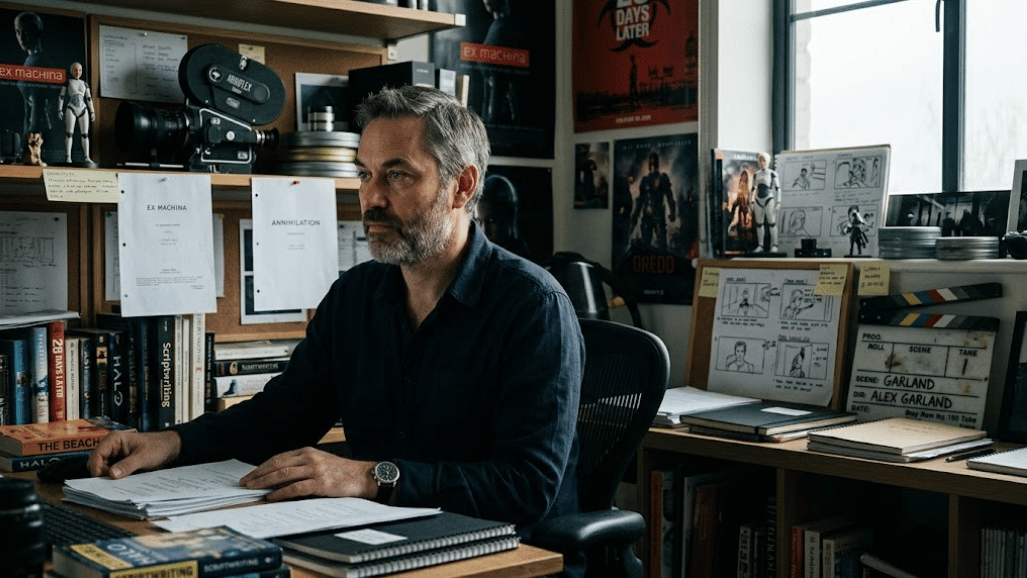
Alex Garland is a British novelist, screenwriter, producer, and director known for ambitious genre storytelling. His work includes 28 Days Later, Ex Machina, Annihilation, Civil War, and Warfare. His career also spans bestselling fiction, television, and video games.
Garland often uses science fiction, horror, and conflict to examine human behavior under pressure. Technology, violence, social breakdown, and personal responsibility repeatedly appear in his stories. That combination has made his work recognizable across several different genres.
Career Facts at a Glance
| Fact | Details |
|---|---|
| Full name | Alexander Medawar Garland |
| Born | May 26, 1970 |
| Birthplace | London, England |
| Occupations | Novelist, screenwriter, director, producer |
| Education | University of Manchester |
| Breakthrough novel | The Beach |
| Major early screenplay | 28 Days Later |
| Feature directorial debut | Ex Machina |
| Television project | Devs |
| Recent film work | Civil War, Warfare, 28 Years Later |
| Notable recognition | Academy Award nomination for Ex Machina screenplay |
Direct answer: Garland is an English writer and filmmaker who moved from novels into screenwriting and directing. He wrote 28 Days Later before directing Ex Machina, Annihilation, Men, and Civil War. His career is closely associated with science fiction, horror, war stories, and questions about human behavior.
Who Is Alex Garland?
Garland was born in London on May 26, 1970. He studied art history at the University of Manchester before becoming a novelist. He achieved his first major success before becoming closely associated with filmmaking.
His debut novel, The Beach, appeared in 1996 and quickly attracted attention. Danny Boyle later directed its 2000 film adaptation starring Leonardo DiCaprio. Garland didn’t write that film’s screenplay, but cinema soon became central to his career.
His background helps explain why describing him only as a director misses much of his story. He established his creative voice through fiction and later carried it into screenwriting. Directing became another stage in a career already shaped by storytelling.
From The Beach to 28 Days Later
The transition from novelist to screenwriter became decisive with 28 Days Later. Garland wrote the 2002 film, while Danny Boyle directed it. The collaboration produced an influential modern infection thriller built around speed, fear, isolation, and social collapse. Horror fans may also want to read about the career of Jordan Peele.
The film also introduced themes that would appear throughout Garland’s later work. Institutions break down, ordinary rules disappear, and characters must make difficult decisions. The external crisis exposes internal conflicts.
Garland and Boyle later worked together on Sunshine, released in 2007. Garland wrote the screenplay about a dangerous mission to revive the dying sun. The story combined a large science-fiction premise with psychological tension inside a confined crew.
Why Ex Machina Changed His Career
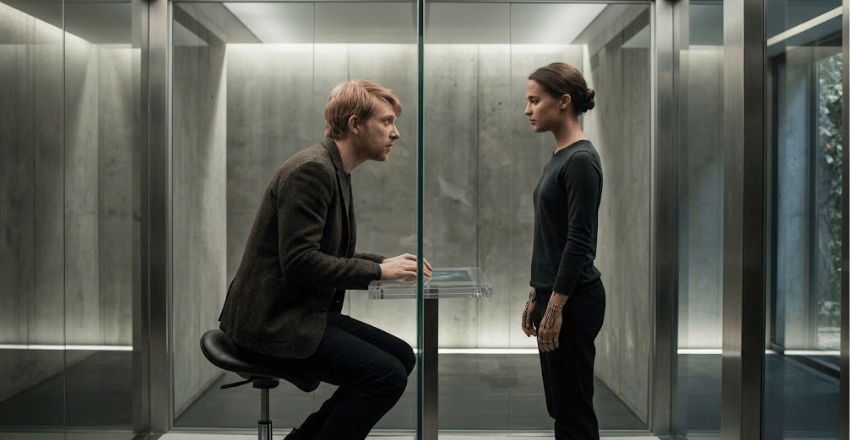
Ex Machina marked Garland’s feature directorial debut and became a defining career moment. Released internationally during 2014 and 2015, it centers on artificial intelligence and human manipulation. Garland also wrote the screenplay.
The film follows programmer Caleb as he evaluates Ava, an advanced humanoid artificial intelligence. Yet the apparent test becomes increasingly difficult to define. Questions about consciousness soon mix with questions about control, desire, deception, and power.
The screenplay earned Garland an Academy Award nomination for Best Original Screenplay. The film also strengthened his reputation as a filmmaker comfortable with demanding ideas. He had moved from respected screenwriter to a prominent writer-director.
Annihilation Expanded His Science-Fiction Vision
Garland followed Ex Machina with Annihilation, an adaptation of Jeff VanderMeer’s novel. Natalie Portman leads the film as Lena, a scientist entering a mysterious region called the Shimmer. Inside, familiar biological rules become increasingly unreliable.
The movie uses transformation as both a physical event and a psychological idea. Its characters encounter strange organisms, altered environments, and unsettling versions of familiar life. Their personal histories also shape how they react to danger.
That approach illustrates an important feature of Garland’s storytelling. Spectacle rarely exists without a larger human question beneath it. The unusual setting gives characters nowhere to hide from their fears and destructive tendencies.
Devs Brought His Ideas to Television
Garland expanded into television with the FX limited series Devs in 2020. He created, wrote, and directed the series. Its story follows a secretive technology company and a mysterious development division.
The series examines determinism, free will, computing, grief, and the consequences of extreme technological power. Those subjects fit naturally alongside the questions Ex Machina raises. Yet television provided more time to develop their philosophical implications.
Devs also demonstrates how Garland moves between formats without abandoning his central interests. Novels, movies, television, and games offer different storytelling structures. His recurring questions remain recognizable even when the medium changes.
Major Movies and Screen Projects
Garland’s filmography becomes clearer when separated by his different creative roles. Some projects feature him primarily as a writer, while others combine writing and directing. His career cannot be reduced to a conventional director’s filmography.
| Project | Year | Major role |
|---|---|---|
| 28 Days Later | 2002 | Screenwriter |
| Sunshine | 2007 | Screenwriter |
| Never Let Me Go | 2010 | Screenwriter |
| Dredd | 2012 | Screenwriter |
| Ex Machina | 2014 | Writer and director |
| Annihilation | 2018 | Writer and director |
| Devs | 2020 | Creator, writer, director |
| Men | 2022 | Writer and director |
| Civil War | 2024 | Writer and director |
| Warfare | 2025 | Writer and co-director |
| 28 Years Later | 2025 | Writer and producer |
| 28 Years Later: The Bone Temple | 2026 | Writer and producer |
This chronology shows a gradual expansion rather than a sudden career change. Garland spent years writing screenplays before taking the director’s chair. He has also continued writing projects directed by other filmmakers.
Civil War and Garland’s American Story
Civil War brought Garland’s filmmaking into a distinctly American setting. The 2024 film follows journalists traveling through a United States fractured by armed conflict. Kirsten Dunst leads the cast as experienced photojournalist Lee Smith.
Garland framed the story around reporters rather than explaining every political event behind the fictional conflict. That decision puts observation, documentation, and violence at the center. The audience follows people trying to record events while surviving them.
The film also continued Garland’s interest in societies under extreme pressure. That concern had appeared much earlier in 28 Days Later. Here, the breakdown occurs through warfare rather than infection or experimental technology.
Warfare and His Collaboration With Ray Mendoza
Garland next worked closely with military veteran Ray Mendoza on Warfare. The pair wrote and directed the 2025 film together. Its story reconstructs a combat experience involving a U.S. Navy SEAL platoon during the Iraq War.
The project differs from Garland’s speculative stories because it is grounded in remembered events. It remains tightly focused on soldiers experiencing combat at close range. That gives the film a different foundation from Civil War.
The collaboration also reflects Garland’s willingness to shift his role according to the project. He has repeatedly resisted the idea that filmmaking belongs to one individual. His career includes collaborations with directors, performers, producers, and technical specialists.
Returning to 28 Years Later
More than two decades after 28 Days Later, Garland returned to the series as screenwriter and producer. Danny Boyle directed 28 Years Later, released in 2025. Their reunion connected Garland’s current work directly with an important early screenplay.
The continuation did more than revisit a recognizable horror property. It allowed the creative team to examine a world changed by decades of infection. Time itself became part of the premise rather than a detail between sequels.
Garland also wrote 28 Years Later: The Bone Temple, released in 2026. Nia DaCosta directed that installment, while Garland remained involved as writer and producer. The arrangement reflects his continuing interest in writing without directing every project himself.
What Themes Define His Work?
One recurring theme is control and what happens when people believe they possess it. Nathan attempts to control Ava in Ex Machina. In Annihilation, the scientists entering the Shimmer confront forces they cannot fully understand.
Another theme is the instability of systems people assume will protect them. Government, technology, military structures, and social rules can all fail in these stories. Characters then reveal their priorities through their choices.
Garland also returns frequently to uncertainty rather than offering simple explanations. His stories often leave room for viewers to interpret motives and outcomes. That approach can make his films demanding, but it also encourages discussion after the credits.
Books and Work Beyond Film
Before movies dominated his career, Garland published three novels. The Beach arrived in 1996, followed by The Tesseract in 1998. The Coma was published in 2004.
His interests have also extended into video games. Garland co-wrote Enslaved: Odyssey to the West with Tameem Antoniades. He later contributed to the story work surrounding DmC: Devil May Cry.
These projects make his career unusually broad for a filmmaker associated with auteur-driven cinema. He has written prose, feature films, television, and interactive entertainment. The common thread is his interest in building situations that pressure characters into revealing themselves.
Why His Career Still Stands Out
Garland’s career shows how a writer can move across creative formats without following a simple path. He began in fiction, became a prominent screenwriter, and later became a director. He has since moved between those roles rather than abandoning one for another.
His most familiar works also cross several genres. Horror drives 28 Days Later, artificial intelligence powers Ex Machina, and cosmic science fiction shapes Annihilation. War and social fracture become central in Civil War and Warfare.
For new viewers, his filmography offers several possible starting points. Ex Machina presents his themes of technology in a compact story. 28 Days Later shows the earlier work of a screenwriter whose ideas would continue developing for decades. Fans of the genre can also explore the movies and science-fiction roles of Zoe Saldana.
Frequently Asked Questions
What is Alex Garland best known for?
He is known for writing and directing science-fiction, horror, and thriller projects. Major titles include 28 Days Later, Ex Machina, Annihilation, Civil War, and Warfare. He also created the television limited series Devs.
Did Alex Garland write The Beach?
Yes, Garland wrote the 1996 novel The Beach. The book helped establish his literary career before his move into screenwriting. Danny Boyle later directed a film adaptation starring Leonardo DiCaprio.
Did Alex Garland direct 28 Days Later?
No, Danny Boyle directed 28 Days Later, while Garland wrote the screenplay. Garland later directed the feature film Ex Machina. He reunited with Boyle as writer and producer on 28 Years Later.
What was Alex Garland’s first movie as a director?
His feature directorial debut was Ex Machina. Garland also wrote its screenplay and received an Academy Award nomination for that writing. The film remains one of his best-known works.
Is Alex Garland still making movies?
Yes, his recent credits include Warfare, 28 Years Later, and 28 Years Later: The Bone Temple. His role differs across those projects, including writing, producing, and directing work. His career therefore continues beyond the writer-director model associated with several earlier films.
What should you watch first?
Ex Machina is a useful introduction to Garland’s recurring interest in technology, power, and human behavior. 28 Days Later shows his earlier screenwriting work and interest in social collapse. Viewers who want a larger-scale production can start with Civil War.
The Continuing Career of a Genre Storyteller
Garland has built a career around unsettling questions rather than one dependable genre formula. His stories ask what happens when technology, institutions, bodies, or societies stop behaving as expected. Characters must then decide what they value without familiar protections.
That approach connects projects that otherwise look quite different. A contained artificial-intelligence drama and a large war film can still share concerns about power and human choices. His changing roles also show those interests aren’t tied to directing alone.
For audiences discovering his work, the next step is simple. Start with the project closest to your preferred genre, then follow the connections across his career. The path from The Beach to his recent films reveals how consistently those questions have evolved.